Singapore Bar Cabinets: Veneer vs. Solid Wood Cost Breakdown
For a bar cabinet in Singapore, the purchase price is only the beginning of the financial story. Veneer may reduce the initial outlay, while solid wood can retain more of its value through repeated use, movement, repairs and refinishing. The fair comparison is not simply “wood or not wood”; it is what the cabinet will cost over 5 years in a real home.

My colleague and I measured and inspected a 120 cm veneer bar cabinet and a 120 cm solid wood bar cabinet last month before a Singapore delivery. The veneer unit weighed about 34 kg, compared with 51 kg for the solid wood version. Both fitted through the tested 82 cm doorway, but the solid wood cabinet needed a two-person carry because its 51 kg mass was concentrated in the solid timber side panels and frame.
This guide compares purchase price, installation, maintenance, repair and likely resale contribution for owners in HDB flats and condos around Tampines, Bedok and Punggol. Prices below use typical SGD assumptions and include Singapore GST where indicated. The goal is a clear 5-year cost, with no claim that one material automatically suits every home.
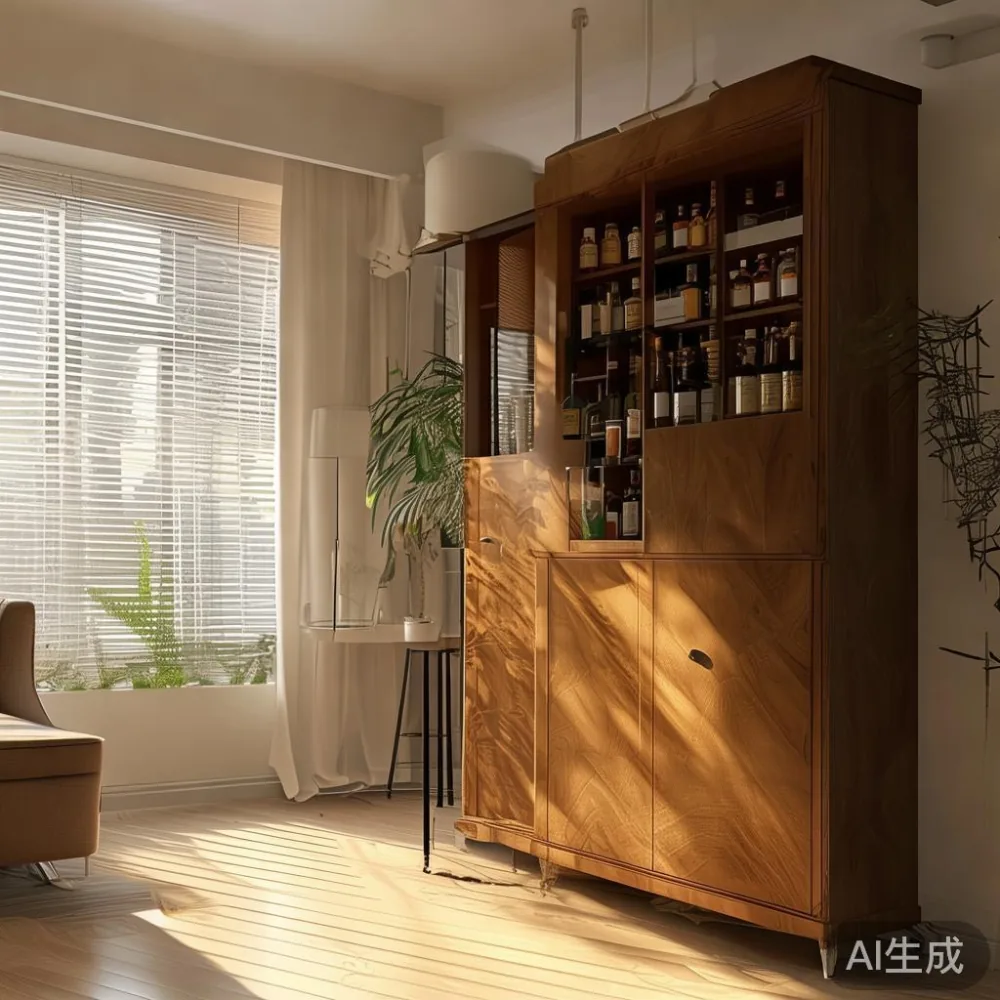
What does a 5-year veneer cost comparison for a bar cabinet include?
A useful 5-year comparison should include the cabinet itself, delivery, stair or lift access, assembly, cleaning products, minor repairs and refinishing. It should also account for the risk of damage. A lower-priced veneer unit that scratches easily may need replacement or restoration sooner, while a solid wood bar cabinet can often be sanded and refinished without changing its dimensions.
For this exercise, I used a 120 cm wide, 40 cm deep and 85 cm tall bar cabinet with two doors, three drawers and a 6 cm deep wine rack. The assumed purchase prices were SGD 1,480 for a good-quality veneer cabinet and SGD 2,380 for a comparable solid wood cabinet, both including 9% GST. The difference is SGD 900 before access and lifetime costs.
The cabinet needs enough front clearance to open its doors. A 120 cm unit with two 55 cm doors needs approximately 120 cm of usable space across its width. Depth should be at least 45 cm when opened, and at least 60 cm if a stool or drinks trolley sits in front. These measurements matter in compact Singapore layouts because a beautiful bar cabinet that cannot open fully is poor value.
A reasonable cost model also includes a 5-year ownership period, not just a warranty period. We assume one move, normal indoor use, occasional dampness near a kitchen and no direct sunlight on the doors. Replacement costs for the entire unit are excluded because that would turn maintenance into a forced replacement.
How much does a veneer bar cabinet cost over 5 years?
For the 120 cm model, the veneer cabinet starts at SGD 1,480. Add SGD 120 for delivery and assembly, SGD 80 for a 5-year supply of wood-safe cleaner and conditioner, SGD 70 for two hinge adjustments, and SGD 150 for one partial refinishing or veneer repair. The estimated 5-year outlay is SGD 1,900.
Delivery takes about 7-10 working days after production confirmation. In an HDB lift lobby, a van should reach the block, but the lift itself may have a depth of 110-140 cm and a door width of about 80-90 cm. The 120 cm cabinet therefore usually travels upright or on its side with protective blankets. If it cannot pass a tight corridor turn, an external assembly charge can add SGD 80-SGD 160.
Water marks are a recurring issue with kitchen-adjacent bar cabinets. A satin lacquer veneer finish may develop visible rings around glasses within 12-24 months if left wet. Budget SGD 20-SGD 40 for a treatment cloth and mild cleaner each year. Deep scratches or chipped edges are harder to disguise because the decorative face veneer is only about 0.6 mm thick in many products.
That thin face layer affects repair economics. A small scratch may be treated with a wax touch-up kit for SGD 15-SGD 35. A larger damaged panel may require a new face sheet, which can cost SGD 180-SGD 350 including labour. If moisture has loosened the adhesive beneath the veneer, replacement may cost SGD 250-SGD 450, and the panel can look slightly different from the original.
Veneer can still be a sensible choice when the cabinet is decorative, light in use and kept away from moisture. Its lower mass also reduces strain on lift operators and makes installation easier. The financial risk is that damage costs accumulate near the edges and corners, where knocks occur most often.
How much does a solid wood bar cabinet cost over 5 years?
The comparable 120 cm solid wood bar cabinet is priced at SGD 2,380 including GST. Delivery and assembly add SGD 140 because of its 51 kg weight. Add SGD 100 for cleaning oil, SGD 60 for preventive hinge and drawer maintenance, and SGD 180 for one careful refinishing job. The estimated 5-year outlay is SGD 2,860.
The price gap over 5 years is therefore SGD 960 against the veneer model in this example. That is not the full economic picture. A restored solid wood cabinet usually retains more function and appearance than a patched veneer cabinet. If the unit is still serviceable after 5 years, solid wood can carry a higher second-hand value; however, the amount depends on design, condition and local demand, so it should not be treated as guaranteed savings.
Solid wood is easier to repair locally. A 2-5 mm deep scratch can be filled with a matching wood filler and sanded. A worn edge can be eased and re-oiled without replacing a 0.6 mm decorative skin. A full refinishing service may cost SGD 280-SGD 450 for a 120 cm cabinet, but it preserves the original dimensions, door alignment and hardware positions.
Wood movement is the main technical consideration. Solid timber expands and contracts as humidity changes, so the carcass needs correct joinery and the doors need adjustable hinges. The cabinet should not be pressed tightly against a cold wall or placed directly beside an air-conditioner vent. A 10-20 mm allowance behind the unit is useful in air-conditioned Singapore interiors.
For owners considering a coordinated home, the same material logic applies to related pieces. A solid wood sofa or bed frame may use engineered internal frames with timber or upholstered surfaces, while a solid wood dining table shows wear more openly but can be refinished. A wardrobe needs larger panels and more precise movement control, whereas a nightstand is easier to maintain. A marble table introduces a separate stone-care budget, so it is not a direct material comparison with a timber bar cabinet.
Which is cheaper to deliver and install in a Singapore home?
Veneer wins the installation stage in most cases. The sample weighs 34 kg, which one person can manage safely with two-person handling for stairs. The solid wood version weighs 51 kg and is better carried by two people. Singapore HDB lift interiors commonly measure around 110-140 cm deep, and corridor widths of about 100-140 cm are common, although block-specific dimensions vary.
A 120 cm cabinet fits many standard corridors if it is turned carefully. A 150 cm unit may not, so buyers should measure the route from the lift to the living room, including the door width, hallway turns, skirting and any balcony threshold. The carton should be checked before the movers arrive. If the shortest route has a 76 cm corner with a 120 cm cabinet, on-site dismantling may add SGD 100-SGD 250.
Condo loading arrangements can add another layer. The driver may need to park at a designated bay, use a service lift or book a loading slot. Allow 7-12 working days for a made-to-order solid wood bar cabinet, compared with 5-9 days for a standard veneer model. If the building requires a protection mat or lift reservation, the property manager may request 3-7 days’ notice.
Here, the 34 kg versus 51 kg difference is more than a specification. Fewer people, less handling and fewer protective blankets reduce the chance of scuffs. In a lift with a 900 mm door opening, the solid wood carton may still fit, but tight turns can make it awkward. Clear the route beforehand and measure the actual lift car, not just the lift doors.
What are the hidden costs of veneer and solid wood?
Hidden costs include moisture damage, edge lifting, finish degradation, moving labour and replacement hardware. Veneer’s engineered core is dimensionally stable, which is an advantage in Singapore’s humid climate, but its thin decorative layer can chip or peel. Solid wood offers a thicker repairable surface, yet it can move, check or fade if exposed to strong sun and abrupt moisture.
Cleaning methods matter over 60 months. Use a slightly damp cloth on veneer, dry it within 10 minutes and avoid silicone-heavy sprays that can leave a haze. For solid wood, use a pH-neutral cleaner followed by a thin coat of hard wax or furniture oil every 6-12 months. Do not flood either surface, and keep standing drinks on the bar cabinet’s protected top.
For a Singapore buyer comparing styles, French light luxury often balances pale woods, moulded details and reflective finishes. Post-modern light luxury can pair warm timber with clean lines and darker metal accents, while American light luxury tends toward restrained profiles, generous spacing and practical comfort. The vocabulary of French bed vs Japandi bed is useful for bed frames, but the bar cabinet itself needs the same moisture, access and stability checks.
Material choice should match the room. If the cabinet will hold bottles, display ceramics and serve drinks at gatherings, solid wood is usually the more repair-tolerant option. If it will mainly conceal storage in a dry living room and the initial budget is limited, veneer can be reasonable. The is French provincial wardrobe worth it question has similar trade-offs: visual character can justify a premium, but hinges, moving space and repairability matter before decorative details do.
How do kitchens, bar areas and light-luxury rooms change the decision?
A bar cabinet placed beside a wet bar or kitchen needs a dry zone. Allow at least 30 cm from a sink or dishwasher splash zone where possible. A solid wood top may tolerate occasional wiping better than an untreated veneer edge, but standing condensation should still be avoided. A fitted 60 cm bar cabinet can work beside a dining table, while a 120 cm unit can become the visual anchor of a larger condo living room.
Minimalist for small living room decisions often favour a shallow 35-40 cm cabinet with closed storage. Sliding doors can reduce projection, although they may need more internal clearance for bottles. A rounded corner profile can improve circulation in an HDB living room, while a narrow profile can sit beside a TV console without closing the walkway.
American for guest room planning applies when a bar cabinet supports overflow storage or a refreshment area. Use a 100-120 cm model with adjustable shelves, closed compartments and a restrained finish so it can transition between hosting and everyday use. If it includes a glass door, budget SGD 60-SGD 120 for protective film or glass treatment and check whether the hinges can be adjusted without removing the door.
Colour selection affects future repair visibility. Pale oak and cream finishes show stains more quickly but can be spot-treated carefully. Walnut and deeper browns disguise small marks, although a very dark finish may need a specialist when refinishing. Always request a physical finish sample before ordering, especially when mixing it with a solid wood sofa, bed frame or marble table.
How should you compare a 5-year warranty and lifetime refinishing?
A 10-year structural warranty is more useful when the written scope covers frame stability, joints, drawer runners and structural cracking, not ordinary finish wear. Ask whether solid wood movement, moisture exposure and moving damage are excluded. A 5-year cost comparison should assume some finish maintenance even when the structure is covered.
Lifetime refinishing can change the long-term calculation if the service is transferable and includes reasonable labour. Before paying, obtain the exclusions, current labour fee, expected turnaround and coverage of hardware, glass and drawer mechanisms. A cabinet may need new felt pads, drawer slides or a gas strut after 5 years; allocating SGD 40-SGD 100 for these parts is prudent.
MIDHILL’s 14-day return policy also allows a buyer to check access and appearance, subject to the stated condition requirements. Measure first, inspect on arrival and retain the packaging until the cabinet has been checked. For a custom bar cabinet, confirm whether made-to-order pieces are returnable and whether a restocking or freight charge applies.
Free shipping over US$350 is useful for international orders, but Singapore customers should request the actual SGD delivery quote because currency conversion, destination fees and access arrangements can change the total. A transparent local delivery fee is easier to compare with the 5-year budget.
Last month, I visited a Tampines HDB flat with my colleague to assess a 120 cm solid wood cabinet that had passed through an 82 cm doorway and a 105 cm corridor. The route worked because the cabinet was delivered in two sections. Ten months later, the owner reported minor scuffing from a move but no swelling or joint failure. The cabinet could be handled with a simple maintenance kit rather than a full replacement, which supports the value of repairable timber.
What do five-year ownership examples show?
Budget Scenario A uses a 100 cm veneer bar cabinet at SGD 1,180 including GST. Delivery and assembly cost SGD 100, 5 years of cleaner cost SGD 60, two service visits total SGD 70, and one veneer repair costs SGD 140. The 5-year total is SGD 1,550.
Budget Scenario B uses a 100 cm solid wood bar cabinet at SGD 1,980 including GST. Delivery is SGD 120, maintenance products cost SGD 80, two service visits total SGD 80, and one partial refinishing job costs SGD 160. The 5-year total is SGD 2,420. Solid wood costs SGD 870 more in this lighter-touch use case.
Higher-Use Scenario C uses the 120 cm models from earlier. The veneer bar cabinet reaches SGD 1,900 over 5 years after SGD 150 in repair work. The solid wood bar cabinet reaches SGD 2,860 after refinishing and the heavier delivery charge. The difference is SGD 960. In exchange, the solid wood cabinet has a thicker repair surface and may retain more utility if the family continues to host guests.
These figures are planning estimates, not fixed quotations. Local timber prices, hardware brands, finish specifications and building access can shift the result. A self-assembled veneer cabinet might reduce the initial total by SGD 80-SGD 150, while custom solid wood joinery can raise the price by SGD 300-SGD 700. The numbers should be recalculated with the seller’s written quotation.
What should a Singapore buyer choose?
Choose veneer when the cabinet will be used lightly, the budget is firm, dry storage is the priority and you accept a smaller repair budget. Choose solid wood when the bar cabinet will be used frequently, the household moves, children or guests create more contact and long-term refinishing has financial value.
For most frequently used bar cabinets in Singapore, solid wood offers the stronger 5-year ownership case despite its higher purchase price. Its repairability can prevent a small scratch from becoming a full cabinet expense. Veneer remains practical for secondary storage and dry living-room displays.
Before ordering, measure the lift, corridor and door route; confirm the 9% GST-inclusive price; ask what the 10-year structural warranty covers; and compare the real 5-year service quote. If the room design is being developed around a French bed vs Japandi bed, a solid wood dining table or a marble table, coordinate the cabinet’s depth and wood tone so it functions as part of the home rather than a separate statement.
MIDHILL light luxury sofa searches often lead buyers toward coordinated living spaces, but the bar cabinet still deserves the same fit-and-material discipline. Measure twice, select a finish you can maintain, and compare the whole 60-month cost. A lower opening figure can be sensible; a cabinet that remains repairable and usable usually delivers the more convincing long-term value.