Understanding the Factors Behind Solid Wood Furniture Pricing in Singapore
Solid wood furniture is often sold with a promise of warmth, durability and timeless character. That promise is genuine, but it does not explain the full price tag. A 160 cm dining table and a 140 cm bar cabinet can both be described as solid wood while costing SGD 1,200 and SGD 4,800 respectively. The difference is not automatically a sign of one being better; it is usually the result of timber grade, construction, dimensions, hardware, finish, labour and brand economics.
For Singapore homes, the practical comparison is more demanding. A dining table may need to turn through a 90 cm corridor and fit into a lift with a 110 cm door. A wardrobe must be carried up six flights in a Tampines HDB block, while a bar cabinet may need to survive a narrow Punggol condo route with a 95 cm lift door. Price alone does not answer whether a piece will fit or arrive safely.
MIDHILL, established in Foshan in 2008 and exporting to more than 15 countries, illustrates why buyers should examine specifications rather than rely on broad claims. Its 10-year structural warranty, lifetime refinishing service and 14-day return policy can add confidence, yet the cost of an individual piece still depends on what goes into it. Free delivery on orders above US$350 also changes the landed comparison, though local currency, GST and the destination address remain important for Singapore buyers.
Is the timber itself solid wood, and which parts count?
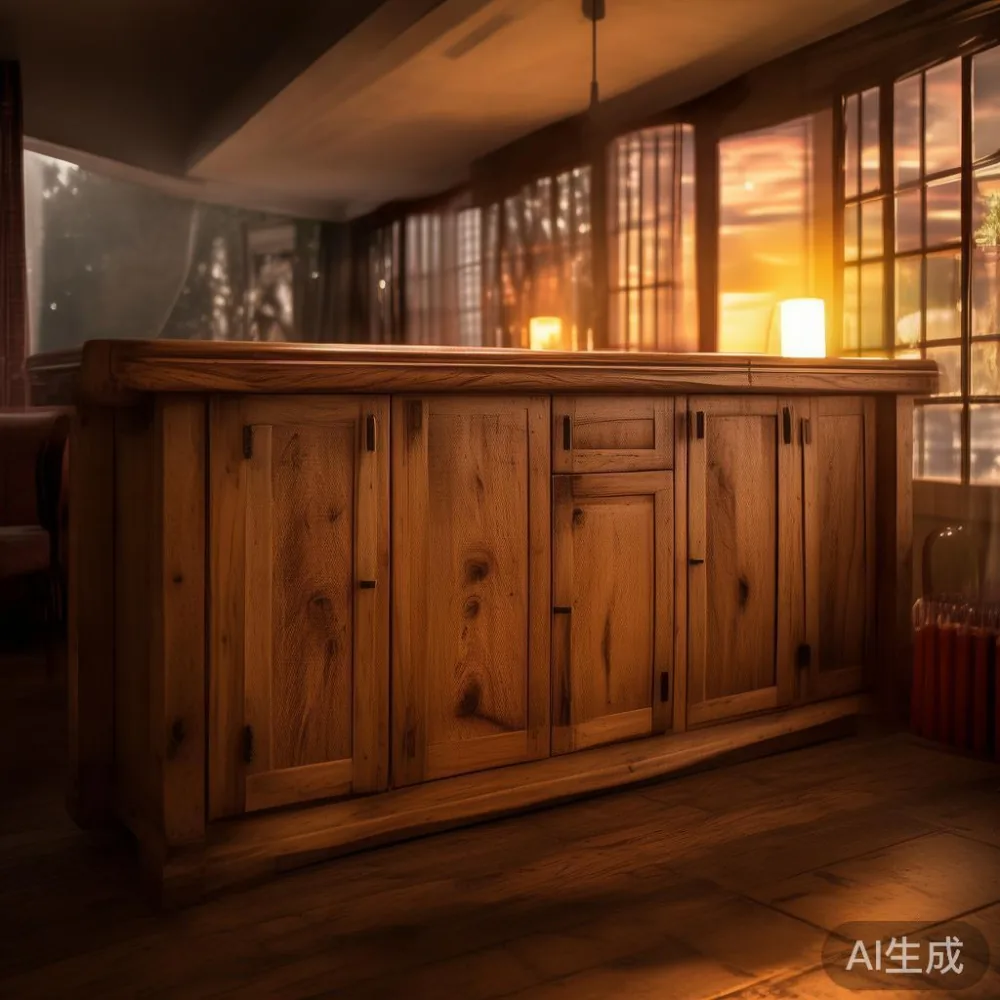
The starting point is the wood species and how much of the visible product is genuinely solid timber. A bar cabinet may have solid oak side panels, veneered plywood backs and engineered drawer bottoms. That combination is normal in furniture production because it controls movement, weight and cost. It is also a reason two apparently identical cabinets can differ by SGD 900.
Solid wood refers to pieces cut from timber, but it does not mean every component has equal commercial value. Oak, walnut, ash, beech and rubberwood have different prices because of availability, grain, workability and yield. A 20 cm-wide oak board with a selected figure may cost far more than a clear 20 cm board from the same species. Veneer can be appropriate for a stable back panel; the key is transparency about the construction.

Ask for a component breakdown. For example, a solid wood sofa frame might use kiln-dried hardwood for the principal rails, plywood or laminated sections underneath, and foam inside the upholstered cushions. A solid wood bed frame should specify whether the headboard, side rails and slats are solid timber. A dining table may use solid timber for the top and apron while using plywood for a lower shelf. A wardrobe should identify the carcass material, door material and internal fittings separately.
Moisture control also affects price. Wood intended for Singapore’s humid environment should normally be conditioned to approximately 8–12% moisture content for interior use, with manufacturing and packing methods designed to limit movement. This is not merely a marketing line. A poorly dried frame can split, bow or twist after reaching an air-conditioned flat.
How much do dimensions and weight add to the price?
Size is one of the clearest price drivers. Timber is sold by volume, so an extra 20 cm in width can add meaningful material cost. More importantly, larger panels require better grain selection, reinforcement and factory machinery. A dining table of 200 cm × 100 cm × 75 cm can require more than twice the timber of a 140 cm × 70 cm × 75 cm table, although the price increase will not be exactly 2.0 times.
Weight provides a rough clue, not a verdict. A 140 cm solid oak dining table may weigh 55–75 kg, while a matching bar cabinet may weigh 45–65 kg. Heavier construction can suggest thick panels, but an overbuilt product can also contain unnecessary material. Ask for the net weight and the load-bearing specification. For a dining table, a tested capacity of 150 kg is more informative than a vague claim of “strong”.
Delivery is where Singapore proportions become decisive. A sofa compressed for transport may fit a lift, whereas a solid wood bed frame delivered as separate parts may need careful assembly. A bar cabinet might measure 120 cm × 40 cm × 85 cm and weigh 48 kg. If the HDB lift door is 80 cm wide and the corridor turns sharply, the cabinet may need to be brought in at an angle or partly dismantled.
Before ordering, record the lift door width, corridor width, stair landing dimensions and the intended room. Add at least 10 cm of working space for packaging on narrow routes. Standard lift and corridor dimensions vary by building, so checking on site is more useful than assuming one model fits every condo.
Why do joinery and furniture-grade construction affect the price?
Joinery tells you how much labour is hidden in the piece. A basic cabinet may use screws, particleboard backs and simple edge banding. A better-made cabinet can use dowels, mortise-and-tenon joints, dovetails, biscuits or concealed hardware, with edges prepared for repeated finishing. Those methods take time, skilled operators and accurate setup, so they increase factory cost.
The visible construction should meet the visible stress points. In a dining table, the apron, legs and top connection need to resist long spans. In a bed frame, the rail-to-post joint should be secure enough for repeated daily use. In a wardrobe, drawer runners, hanging rods and adjustable shelves affect usability more than decorative corner blocks.
Hardware is another measurable factor. A soft-close drawer runner may cost more than a basic steel slide; a solid brass hinge costs more than a plated steel hinge. Handles, hinges, locking mechanisms and suspension should be listed by material and quantity. For a bar cabinet, the difference between one lock and a multi-point locking system can justify several hundred dollars, while a premium hinge set may add SGD 120–300.
Surface preparation is also labour-intensive. Hand-sanding to a smooth finish, filling pores, applying multiple coats and curing each layer take longer than a thin sprayed surface. American light luxury often favours generous upholstery, clean lines and substantial proportions. French light luxury adds more ornamental shaping, while post-modern light luxury may use unusual geometries. These styles affect labour and material use, but they do not guarantee better timber or construction.
How should I compare finishes, protection and maintenance?
Finish is often priced as a package, so separate the coating from the timber. Hardwax oil may highlight grain and allow local repair. Water-based lacquer can offer a more uniform painted surface, while open-pore natural finishes can collect more marks in a busy dining room. A marble table uses a different substrate category: the visible stone slab, its thickness, edge treatment and support system determine much of the cost. A marble-look printed surface should never be described as a solid marble table.
Ask what is included in the quoted finish and what is excluded. For example, a stain-matched finish may add SGD 80–220, while a high-resistance matte coating may add SGD 150–350. Custom sizing can add another SGD 150–500, depending on the factory and material. These are planning ranges rather than fixed quotations, but they make comparisons more realistic.
Protection should match use. A dining table needs a surface that can withstand heat, spills and daily wiping. A nightstand may need only moderate protection, while a bar cabinet near a television or speaker should have stable shelf loading and useful cable management. Check the care instructions, warranty exclusions and repairability. MIDHILL’s lifetime refinishing policy is relevant here because refinishing can extend the usable life of a well-made piece, although the terms should still be read carefully.
For furniture that will be refinished, the substrate matters. Some veneer surfaces can be sanded more cautiously than solid timber; filled joints and coatings determine how much material remains during restoration. A lower initial price can therefore be reasonable if the customer intends to change finishes periodically.
What is the real difference between light-luxury and expensive furniture?
Price can rise through design, scale, comfort, branding and packaging without a proportional improvement in structural quality. A solid wood sofa with kiln-dried hardwood rails and high-density foam may support the body better than a visually elaborate model with weak internal components. The appearance of luxury can come from fabric, proportions and details, but everyday performance comes from the frame, suspension and cushion specification.
Buyers asking how to choose light luxury sofa should compare frame material, foam density, suspension type, fabric composition and dimensions before considering the name. For a Singapore living room, a sofa with a 90–95 cm seat depth may feel more generous than one with an 80 cm seat, yet it can also reduce clearance in a compact flat. This is why a visually premium piece is not automatically a good spatial choice.
Style guides can help, but they should support measurements. If searching for designer French provincial furniture, note that curved profiles, carved details and layered finishes take more workshop time than straight components. If your interest lies in Mid-century modern for apartment layouts, slim legs, tapered shapes and warm timber can create visual space without making the physical footprint smaller.
Marketing phrases such as cheap Modern light luxury furniture may attract attention, but “cheap” and “modern” do not define material grade. Check whether the wording is actually a search phrase rather than a verified specification. A responsible seller should be able to explain the timber, construction, finish and dimensions without requiring the buyer to infer quality from a style label.
How should a Singapore buyer compare the total cost?
Compare like-for-like specifications, then add the costs that appear after checkout. In Singapore, GST is charged at the prevailing rate, so compare pre-GST figures and confirm whether the displayed price is tax-inclusive. Delivery to the lift lobby is not the same as delivery into the unit. Upper-floor delivery, carrying, assembly and removal of packaging may each carry a fee.
For example, a bar cabinet at SGD 2,450 plus 9% GST becomes SGD 2,670.50 before delivery. A move-in service at SGD 90 or an upper-floor carrying charge of SGD 60 changes the comparison. If the item is large or difficult to route, an installer may quote SGD 140–260. Those amounts should be confirmed before ordering, not discovered when the driver arrives.
Return terms affect the risk of buying sight unseen. A 14-day return period can help with size or finish decisions, but the customer may need to arrange transport back to the supplier. Damage on return, restocking fees and original delivery charges should be clarified. Keep the packaging where possible, photograph the item and measure the return route as carefully as the delivery route.
Last month I visited a Singapore furniture showroom with my colleague to compare three solid wood dining tables. One had a thick top but a narrow apron; another had a lighter frame and a 3 cm top; the third used stable, dowelled joints and allowed several leg insets. The sample finish on the third table was slightly less uniform, but the structure felt more considered. It reinforced a simple lesson: finish can dominate a showroom impression, while joints, support and service determine long-term value.
My colleague also measured a display bar cabinet at 118 cm wide, 39 cm deep and 86 cm tall. It weighed 52 kg and had drawers that needed 68 cm of frontal clearance when open. In a compact HDB dining area, the closed dimensions looked manageable; the operating space told a different story. That difference of roughly 20–30 cm around a working cabinet is easy to overlook when planning online.
What should I ask before paying for a bar cabinet?
Ask for the outer dimensions, internal shelf spacing, drawer extension, load rating and net weight. Then request the material map: timber species, any veneer, back-panel construction, joinery, hardware and finish. If a bar cabinet includes a marble table top, ask whether the stone is natural marble or manufactured, how thick it is, and how it is fixed to the cabinet. Support details can affect both price and safe use.
Confirm the delivery plan in writing. Note the lift capacity, door width, corridor turns and number of flights. Ask whether the bar cabinet arrives assembled or in sections, how many people are required, and whether the quotation includes carrying to the unit. A delivery window of 7–14 days is common for some made-to-order lines, but ready-stock timing can be shorter. Custom pieces may take 4–8 weeks, so production time is part of the effective cost.
Some projects also need coordinated products. A dining table may share a timber tone with a bed frame or wardrobe; matching finishes can increase lead time and cost. If you are considering how to style Japanese bed in bedroom layouts, prioritise wall clearance, bedside reach and a low profile appropriate to the room. The same restraint works when considering how to style Japanese sofa in room plans: preserve circulation and let timber, proportion and texture do the decorating.
The most useful price comparison is therefore not “Which listing costs less?” It is “Which construction meets my needs for the next 10 years, and what will the complete delivered and GST-inclusive cost be?” Solid timber, sound joinery, controlled moisture, serviceable hardware and honest measurements provide durable value. Decorative style can add pleasure, but it should not conceal the practical decisions that determine whether a piece suits a Singapore home.