Solid Wood Furniture Cost Drivers: Inside Singapore's Market
Solid wood furniture is often sold with an attractive story: warm grain, sturdy construction and a piece intended to stay in the home for years. The price tag, however, is shaped by a much less glamorous set of factors. Timber species, board dimensions, joinery, hardware, finishes, manufacturing tolerances and delivery logistics all affect the final amount. For a bar cabinet, those details matter because the doors, shelves, frame and countertop must work together without sagging or shifting.

MIDHILL is a Foshan furniture maker established in 2008. Its export experience across 15+ countries gives a useful perspective on pricing: a Singapore buyer is not paying for an identical object to a buyer in another market, because packaging, freight, handling and local taxes can change the landed cost. The purpose of this guide is to explain what creates that cost, rather than treating “solid wood” as a complete specification.
What determines the price of a solid wood bar cabinet?
The starting point is the timber. Solid wood prices vary by species, grade, moisture condition and sheet size. A cabinet built from 18 mm boards uses more raw timber than one made with 15 mm components, but the material difference is only one part of the total. A broad face may show stronger grain movement, knots or colour variation. Grade specifications help control this, but they also affect how much usable material the factory can obtain from each log.
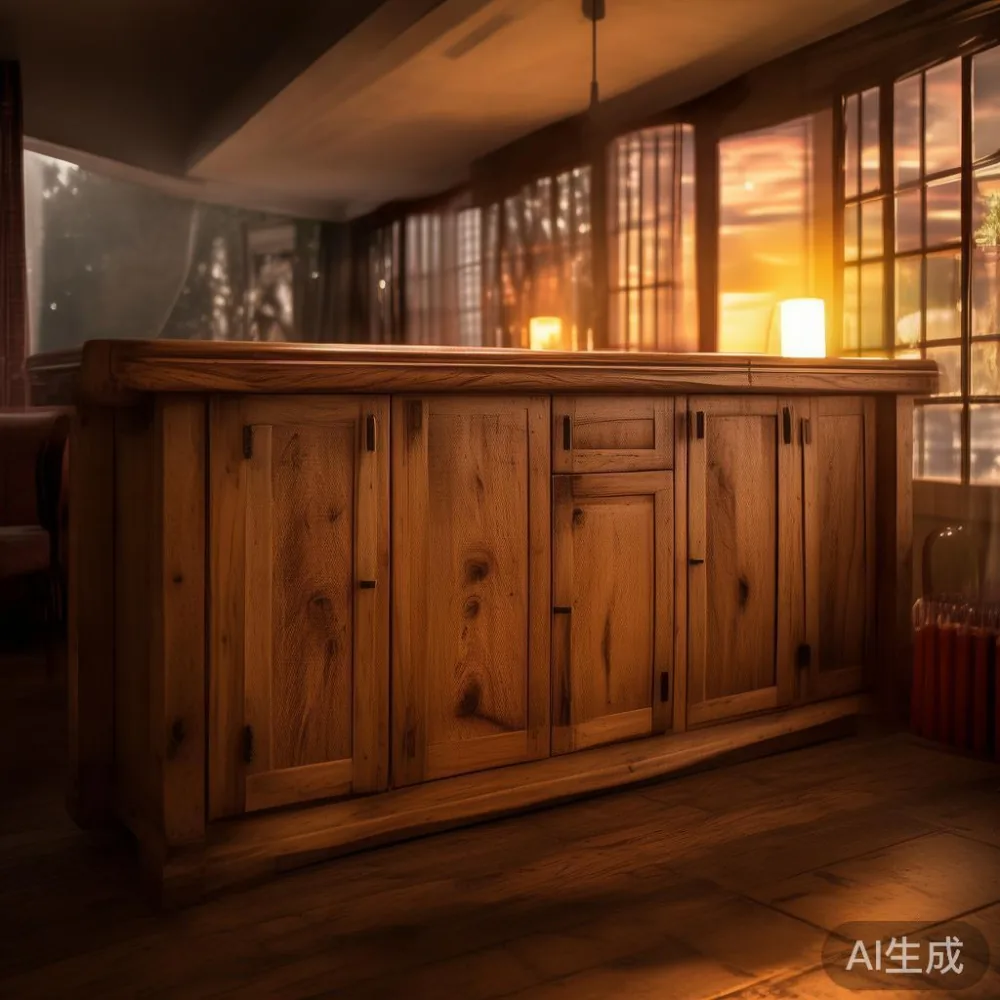
Typical bar cabinet dimensions range from about 120 cm wide and 40 cm deep to 220 cm wide and 50 cm deep. A 160 cm cabinet with two doors and three adjustable shelves may weigh 65-95 kg, depending on the species, shelf thickness, back panel and countertop. Heavier is not automatically better. What matters is whether the structure is designed for the load: a shelf spanning 80 cm needs more support than one spanning 45 cm, and a 30 kg television should not be treated like a decorative object.
Joinery is another price driver. Dowels, confirmat screws, mortise-and-tenon joints, mitred corners and concealed metal fittings create different levels of assembly time and adjustability. Dovetail joints add visible craft value, while imported hinges and runners may add functional value. The construction drawing, load calculations and sample tolerances often explain price differences more clearly than the product photograph.

For customers in Singapore HDB flats and condos in Tampines, Bedok and Punggol, access can materially affect the quote. Lift doors may accept only a cabinet with a packaged width below roughly 90 cm, while corridor turns can require a narrower carton. A large bar cabinet may need to be disassembled, carried through a 86 cm corridor, or delivered as a modular unit. It is sensible to record the lift width, lift depth, doorway width, turning space and staircase dimensions before ordering.
Does solid wood automatically mean expensive furniture?
No. “Solid wood” can describe different parts of a product. The visible frame, doors, drawer fronts, shelves, back panel and legs may not all use the same material or thickness. Some furniture uses solid timber mainly where it is visible and engineered board inside hidden areas. That mixed construction can reduce cost while preserving the appearance of solid wood, but the buyer should ask which components are genuinely solid and which are engineered.
Thickness is easier to compare than the word “solid.” An 18 mm side panel is not twice as expensive as a 9 mm panel simply because it is twice as thick; machining, drying, handling, waste and strength requirements all contribute. The comparison becomes clearer when a supplier states the material for each component and shows the cabinet unloaded. Good transparency lets buyers understand the price instead of relying on a vague category.
Design also affects labour. A flat-pack bar cabinet with machine-drilled holes and simple hardware can be economical. A French light luxury bar cabinet with sculpted edges, routed panels, bronze-toned handles, aligned grain and a veined stone top takes longer to set up and inspect. The final price reflects those production minutes, along with the cost of correcting minor finish variations.
One frequently repeated comparison is a European sofa vs Mid-century modern sofa. The frame may use similar timber in both cases, but the upholstered sofa requires foam density, fabric, stitching, spring systems and shape checks. By contrast, a dining table concentrates expenditure in the top, joints and base. The lesson is simple: compare products by their construction details, not by the broad material label.
Why do some dining tables cost more than others?
A dining table starts with the top. A 200 cm by 90 cm top in solid oak, walnut or ash can require a large, stable board with controlled moisture movement. Slatted construction may use narrower boards and more joints, sometimes improving dimensional stability. A thick 30-40 mm top adds visual weight and machining work, while a thinner top can still be appropriate when supported by a well-designed base.
The base determines whether the table remains stable. Four legs, a pedestal, trestle supports and a boxed frame each solve the problem differently. Restaurant or daily-use dining tables need a base that resists rocking under uneven loads. This is one reason the Modern light luxury for dining room does not have a single fixed price: sculptural legs, a marble table top, concealed storage and premium finish systems can create substantial differences.
Natural timber is affected by humidity. Singapore’s year-round environment can cause expansion and contraction even when the furniture was properly dried in Foshan. A responsible maker should explain care, provide appropriate joinery movement and avoid promising that a solid wood dining table will remain dimensionally unchanged. Controlled workshop moisture is normal manufacturing discipline, not a substitute for sensible indoor care.
Buyers searching for the best Modern bed for 2026 should look beyond appearance. For a queen bed, usable internal dimensions are often about 160 cm by 200 cm, while the external frame may be 165-175 cm wide. Slat spacing, centre support, floor clearance, noise under movement and the removal method for the headboard all affect practical value. A heavier frame can indicate more timber, but the distribution of that timber matters more.
The best Mid-century modern bed for 2026 should also be judged by how its finish handles daily contact. Tapered legs, clean lines and a modest gap above the floor can make a compact HDB room feel less crowded. At the same time, narrow feet may reduce stability if the bed is assembled on an uneven floor. A quality maker balances visual restraint with solid connection points.
What is the real cost of a high-quality wardrobe?
A wardrobe combines large timber panels, repeated machining and hardware that must remain aligned. A typical 180 cm-wide, 58-60 cm-deep wardrobe may contain 6-8 cm of usable hanging depth for long garments, although the internal arrangement varies. The price rises with full-extension runners, soft-close hinges, adjustable shelving, reinforced hanging rails, drawer boxes and a more demanding finish on visible edges.
Door alignment is a telling quality test. Open two hinged doors and compare the gaps; close them and inspect whether the faces sit evenly. Sliding doors can reduce the need for swing clearance, but they introduce track and roller systems. In a Tampines flat with a narrow bedroom wall, a 180 cm sliding wardrobe may preserve more floor space than a 150 cm hinged model with fully opened doors.
For a nightstand, a smaller volume does not necessarily mean a lower price. The Italian light luxury nightstand may use selected veneer, detailed drawers, hand-finished pulls and a precise stone or solid timber top. Its cost comes from refinement and tolerances rather than the number of cubic centimetres. A practical 45 cm-wide unit may need two shelves, a cable opening and a stable drawer, while a 60 cm unit may include concealed charging ports.
MIDHILL’s solid wood sofa, bed frame, dining table, wardrobe and nightstand ranges illustrate this difference in scale. A sofa consumes upholstery labour, a bed frame concentrates on structural supports, and a wardrobe adds repetitive hardware work. Their prices should be compared within each product type, using the same material, thickness, finish and warranty terms.
How much do hardware and finishes change the final quote?
Hardware is measurable. A concealed soft-close hinge may cost several times more than a basic cup hinge. Full-extension ball-bearing runners, reinforced corner brackets and adjustable shelf supports add cost, but they affect daily use. For a bar cabinet, the drawers should carry bottles and glassware without scraping, and the doors should close without catching the adjacent panel.
Finish is another common source of confusion. Clear lacquer, matte lacquer, oil, wax and stain are not equivalent. A multi-stage painted finish may require more preparation to avoid texture around joints, while oil highlights grain but may need more frequent maintenance. Matching the finish across doors, shelves and frames takes process control. White and pale colours can also reveal dust and handling marks more readily than deeper tones.
Marble or stone tops introduce their own variables: slab thickness, veining, cut, edge treatment, support and reinforcement. A marble table is not priced merely by surface area. A 12-20 mm top on a dining table may require a supporting frame that prevents the stone from flexing. On a bar cabinet, the top must also relate safely to the cabinet carcass and any electrical equipment.
Light-luxury positioning can be clear without depending on exaggerated ornament. American light luxury often emphasises generous proportions, warm woods and restrained upholstery. French light luxury may use curved profiles, elegant hardware and pale, tactile finishes. Post-modern light luxury can combine contrasting shapes and disciplined geometry. The price should follow the execution: joinery, edges, touch points, alignment and finish consistency.
Why does delivery cost more than many buyers expect?
Solid wood is heavy, bulky and vulnerable to movement. Proper protection may include foam corners, cardboard panels, moisture-resistant wrapping and a fitted carton. A 160 cm bar cabinet weighing 85 kg may require two people, a trolley and a stair carry, even if the lift is usable. These services should be separated in the quotation so the buyer can distinguish product cost from access requirements.
For Singapore orders, delivery may take 5-14 working days after production, depending on stock status, finish selection and peak periods. Someone who wants the best Mid-century modern bed for 2026 may need to allow extra time for a made-to-order finish. MIDHILL provides free shipping for orders over US$350, although the converted Singapore delivery charge should still be confirmed because freight allocation, access and remote-area surcharges can differ.
Returns are another practical consideration. A 14-day return period gives time to check scale, colour and condition, but it does not remove the need for careful measurement. If a lift allows a packaged width of 88 cm, a 91 cm carton will not pass, regardless of how attractive the product looks in the showroom. Singapore’s 9% GST should also be shown clearly on the final invoice.
Before confirming a bar cabinet, I would record a delivery checklist: building type, unit number, lift interior width and depth, lift door width, corridor width, doorway dimensions, parking distance and preferred delivery window. In a recent project, my colleague measured a condo lift at 82 cm wide and 110 cm deep. The original cabinet had a 96 cm carton, so the order was changed to a modular design with a maximum 79 cm package. The smaller cart cost only 8% more than the original design, yet it avoided a failed delivery and a likely return fee. That small measurement changed both the installation method and the final quotation.
How can you compare two quotations fairly?
Begin with the dimensions and material map. Ask each supplier to state the species, panel thickness, solid-versus-engineered components, countertop material, back-panel construction, drawer and hinge type, finish type and warranty. A numerical comparison sheet makes gaps visible. For example, one bar cabinet may use 18 mm frames and 15 mm shelves, while another uses 20 mm frames and 12 mm shelves; the quote should explain what each construction is intended to achieve.
Next, test function. Check that doors align, drawers run, shelves sit level and the unit does not rock. For a dining table, look beneath the top and examine the base connection. For a bed frame, test the centre support and slat spacing. For a wardrobe, open every door and drawer. A showroom piece with concealed compartments can be more revealing than a long paragraph of product copy.
Then separate the purchase price from the ownership commitments. A 10-year structural warranty is a defined period; lifetime refinishing is a separate service whose terms should be confirmed in writing. Scratches, moisture exposure, misuse and normal colour changes may have different rules. Asking for these terms in writing prevents a marketing phrase from carrying more meaning than the contract permits.
Finally, compare the total cost. Include GST, delivery, lift or floor handling, assembly, extra shelves and any fabric or finish upgrade. A lower item price can become a higher household cost if the cabinet must be modified for access. Conversely, a slightly higher quotation may include more solid runners, clearer warranties or better packaging.
Buyers looking for for sale Industrial furniture should pay particular attention to fasteners, brackets and load distribution. “Industrial” can indicate a style or a construction standard; it does not automatically establish the steel grade, powder-coating thickness or timber moisture treatment. The visual vocabulary may be broad, but the measurable specification should remain specific.
The price of solid wood furniture is therefore not determined by one heroic material claim. It is the combined result of timber selection, component dimensions, construction methods, hardware, finish work, quality control and logistics. For a bar cabinet, a dining table or any other solid wood piece, the most useful quote is the one that makes those measurable decisions clear. That clarity gives buyers a firmer basis for comparison and often leads to a more sensible final decision.