Lacquered Bar Cabinet Care in Singapore: A Tropical-Climate Guide from MIDHILL
I still remember the afternoon I visited a friend's new walk-up in Punggol. She had unpacked a lacquered bar cabinet the previous weekend, set it against the living room wall under a window that catches the late sun, and within nine days a faint, cloudy bloom had appeared along the right door panel. The culprit was not bad craftsmanship. It was the climate. Relative humidity in Singapore drifts between 65% and 85% for most of the year, afternoon indoor temperatures around her unit sat near 30°C, and the cabinet sat 1.5 metres from a balcony slider that stays cracked open from 7am to 11pm. That is the environment every lacquered piece in a Tampines, Bedok, or Punggol home has to survive.
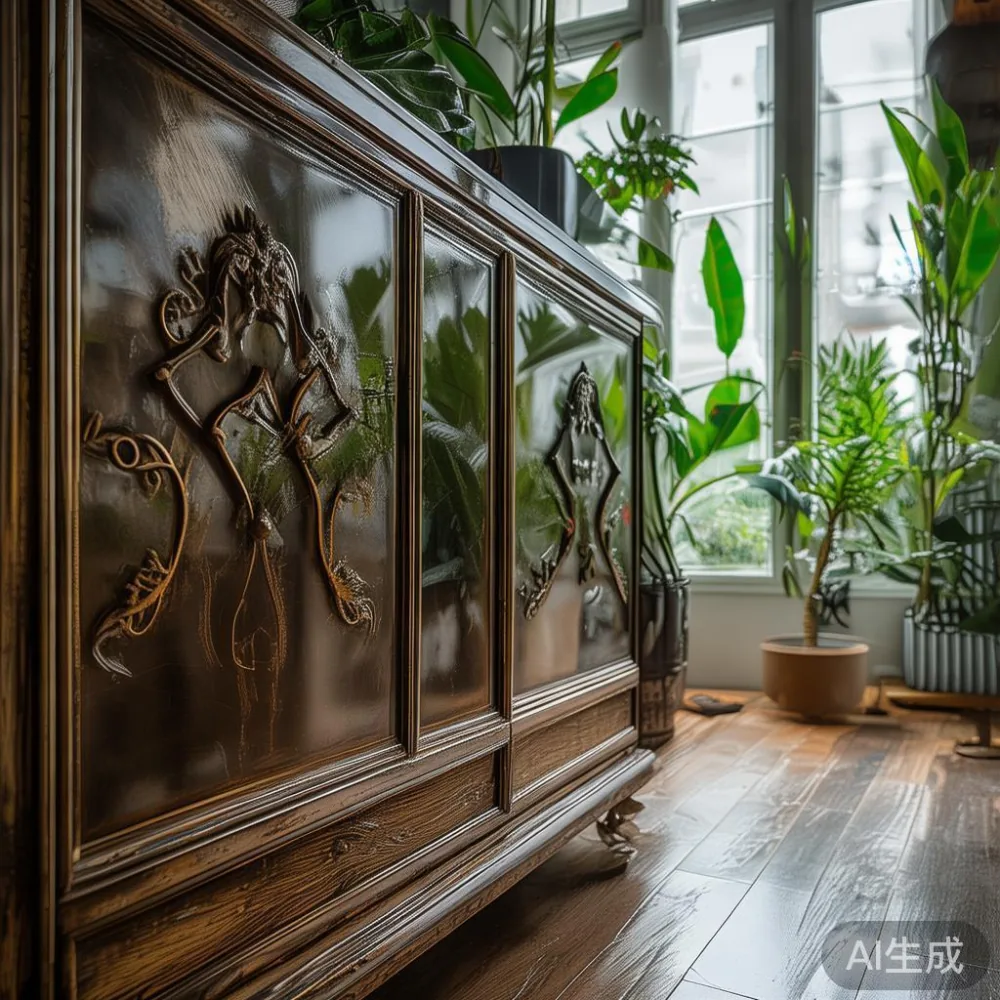
Lacquer is a beautiful finish. It catches light the way French light luxury designers like Pierre Yves Rochon intend it to, and it gives a bar cabinet the deep, mirror-like depth that pairs so well with post-modern light luxury interiors. It is also a film finish, which means it has a finite thickness (usually 0.08–0.15 mm across three to seven coats) and behaves predictably when humidity, heat, and light are steady — and very unpredictably when they are not. This guide is built around Singapore HDB and condo realities: 90 cm corridor widths on certain floors, lift openings of about 80 cm on older blocks, lift cargo limits near 250 kg, the year-round humidity curve, and the 9% GST that applies on delivery. It is also built around MIDHILL's own lacquered pieces — bar cabinets, solid wood sofa bases, dining tables, bed frames, wardrobes, nightstands, and marble accent tables — and what our Foshan workshop has learned since 2008.
Why does a lacquered bar cabinet go cloudy or sticky in Singapore?
A direct, quotable answer: lacquer goes cloudy or sticky in Singapore because humidity penetrates micro-pores in the film and lifts it from the wood underneath, and the only real protection is keeping relative humidity between 45% and 60% around the cabinet. Singapore's ambient humidity is too high (averaging 70–80% outdoors, often 65–75% indoors even with air conditioning), so the lacquer never gets a chance to fully cure in a stable environment and instead works against the substrate year after year.
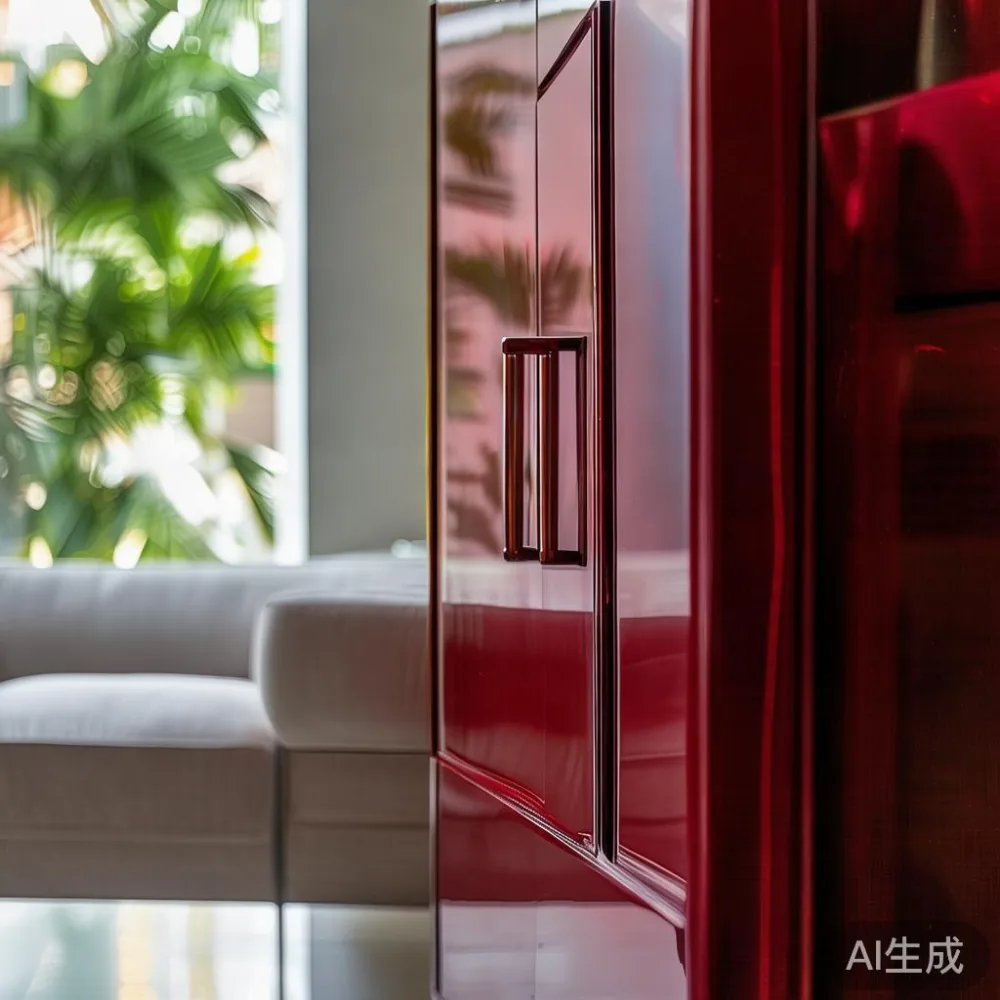
I have seen three patterns repeatedly. The first is white haze, usually along the bottom 30 cm of doors and on side panels — that is moisture wicking up from a tiled floor that was mopped forty minutes before. The second is an orange-peel texture on top surfaces under a ceiling spotlight, and it is caused by a 3–4°C temperature gradient between the lacquer (warmer) and the air (cooler with the aircon running). The third is tackiness near the handles, and that one is almost always hand oils and humidity together, never one without the other.
Two numbers worth remembering: keep the room between 22°C and 26°C, and aim for 45–60% RH. A S$35 digital hygrometer from any Tampines Mall shop will pay for itself inside the first humid spell.
What is the difference between American accent chair and modern furniture?
A direct, quotable answer: the difference is that an American accent chair is a single decorative piece meant to add character to an existing room, while modern furniture describes a whole category of pieces defined by clean lines, minimal ornament, and a specific 20th-century design vocabulary. The accent chair is a role; "modern" is a style that can apply to a bar cabinet, a sofa, a dining table, or an entire room.
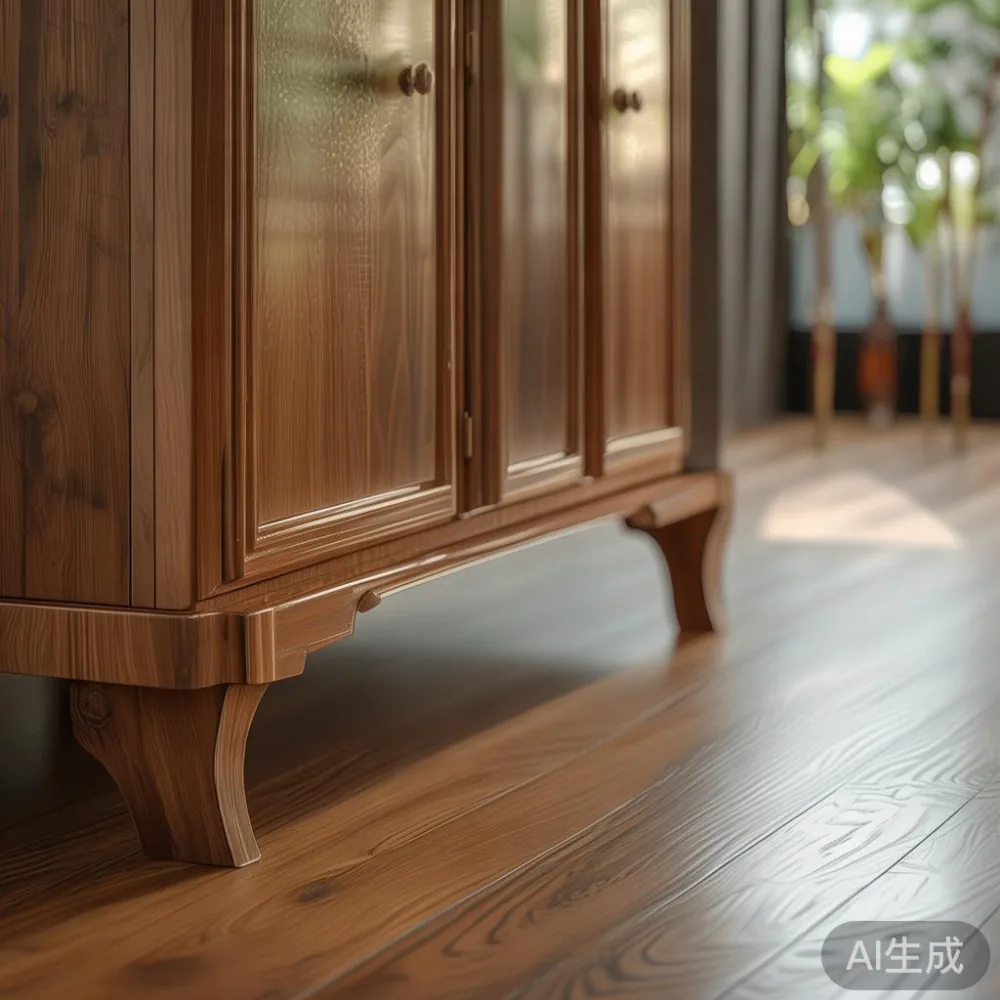
That distinction matters for lacquer care, because an American accent chair is usually a soft-upholood statement you rotate every few years, whereas a lacquered modern piece — including a bar cabinet — is a long-stay object that has to survive the climate for fifteen or twenty years. American light luxury interiors tend to mix the two freely: a French light luxury console paired with an American accent chair in a post-modern light luxury room, all anchored by a lacquered bar cabinet in black walnut or ash. Knowing which is which helps you decide what to protect and what to refresh.
How should I acclimatise a new bar cabinet before placing it against the wall?
Three days is the minimum, and seven is safer during the December to February wet period. A solid wood bar cabinet that left Foshan at 12% moisture content and arrives in a Bedok condo at 16–18% indoor RH needs time to equalise. Leave the cabinet in its MIDHILL carton, opened at the top, in the room it will live in. Do not place it near the aircon louvre or under a window. After three days, slide it into position, leaving a 5 cm gap at the back so air can move behind it.
This matters more in walk-ups and certain older HDB blocks than in new condos. A friend in a Punggol North corridor block with 90 cm doorways had the boxes brought up by two men in 20 minutes; the lift was fine, but the landing turn was the test. Plan the move before the carton is opened.
What is the right daily and weekly cleaning routine for a lacquered bar cabinet?
Daily: a 10-second pass with a dry microfibre cloth (around S$8 for a pack of six) along the top and door fronts. Weekly: a barely-damp wipe with a clean microfibre and a drop of neutral pH cleaner (S$12–S$25 for 500 ml), followed by a dry pass within 30 seconds. Never spray directly onto the lacquer — spray onto the cloth, then wipe. Never use silicone polishes, furniture sprays with silicone, vinegar neat, ammonia, or kitchen degreaser.
Twice a year, ideally once before the June–September wet peak and once after, wipe down with a dedicated lacquer refresher (S$30–S$60 for 250 ml). Apply with a fresh microfibre in straight, overlapping lines, not circles. Buff after four minutes. This single habit is the single biggest reason our MIDHILL customers in Singapore keep their bar cabinet finishes looking new at year five.
How do I control humidity and sunlight around a lacquered bar cabinet?
Run the aircon to maintain 22–26°C and 45–60% RH where the cabinet is. A small dehumidifier set to 55% RH (around S$180–S$280 for a 6-litre unit) is the most reliable tool for cabinets near a balcony slider or kitchen door. If you do not want to run a dehumidifier, a 2 kg silica gel tub (S$20, regenerable monthly in a 120°C oven for 90 minutes) inside the base of the cabinet absorbs slow leaks.
Light is the second enemy. UV breaks down lacquer resins and yellows pale finishes within months. A bar cabinet 1.5 metres from a west-facing window in a Punggol Waterway terrace will fade; the same cabinet 4 metres back, behind sheer linen, will keep its colour for years. Sheers cost around S$25–S$60 per running metre and protect lacquer much more expensive than that. For glassware inside the cabinet, an LED strip on a 30-minute timer (S$15) gives display light without the UV load of older downlights.
What should I do about spills, rings, and heat on the lacquer top?
Wipe spills within 60 seconds, always with a damp cloth first and a dry one straight after. Ice buckets and whisky bottles leave rings because the cold spot condenses moisture under the lacquer film; use a coaster of felt or cork (S$10–S$20 for a set of six) every time. A marble accent tray on the top is decorative and protective at the same time, and matches the Fatt-Choy greens and gold accents you see in Lunar New Year styling across Tampines.
Heat sources are the third silent killer. A bar cabinet top that takes a hotpot tray at 110°C will blush within a minute. Use a trivet. If you have ever seen a white ring that does not wipe off, it is almost always heat, not water. For shallow marks, a 2,000-grit wet-and-dry paper (S$6 per sheet) used with water, followed by the lacquer refresher, will rescue nine out of ten light marks. Deeper marks need a refinisher — which is where our MIDHILL lifetime refinishing service earns its keep, since it is included for the original owner on every cabinet we have shipped since 2014.
How do I handle moving, corridor widths, and delivery in Singapore HDBs?
Most HDB corridor widths are 1.2–1.5 m, lift openings 80–90 cm, and lift depths around 1.4–1.7 m. A 180 cm bar cabinet in its carton will usually fit a standard lift, but the corner turn at the lift landing is the tight point. Measure first. Older blocks in Bedok and Tampines sometimes have narrower landings around 90 cm, and a long carton may have to come in vertically.
Plan the move like this: measure door, corridor, lift opening, lift depth, and any 90° turn, then add 10 cm clearance. MIDHILL's team in Singapore offers site surveys for any cabinet, bed frame, dining table, wardrobe, or nightstand above a certain weight, and the survey is free if delivery is within 14 days. Above 80 kg we use a two-man white-glove team; the surcharge is S$60 for ground floor and S$10 per floor above for walk-ups without a lift, capped at S$140. Free shipping kicks in above US$350, which on SGD invoices sits around S$475 before GST.
What about long-term storage and the December monsoon season?
If you travel for four to six weeks over Christmas and the unit sits empty with the aircon off, humidity inside will track outdoor humidity closely and reach 75–80%. Before you leave, run the dehumidifier to 55% RH and empty the condense tank. Leave two silica tubs inside the cabinet. Open the cabinet doors 2 cm so the interior does not stay stagnant. Set a neighbour or a relative to check every 10 days; a stuck dehumidifier and a leaking door seal in an empty unit is the most common cause of cabinet damage we see at the Singapore workshop each January.
On return, wipe the cabinet with the lacquer refresher before you put glassware back. That is the moment most owners miss. The cabinet has done 30 days of hard work and a 20-minute care session resets everything.
Can a lacquered bar cabinet match a solid wood sofa, bed frame, dining table, wardrobe, nightstand, or marble table?
Yes, and this is where lacquered pieces earn their place in a complete set. A solid wood sofa frame in ash or white oak, paired with a black walnut lacquered bar cabinet, a marble accent table, and a black walnut nursery furniture dresser in the nursery, reads as American light luxury in the living zone and post-modern light luxury in the family zones. The wood species do not have to match — the lacquer sheen and the grain direction should. A satin lacquer cabinet next to a high-gloss dining table will look mismatched; keep the sheen level consistent across the room.
For households mixing a solid wood bed frame, a wardrobe with a lacquered front, two nightstands in the same wood, and a marble table in the entry, the bar cabinet is the natural anchor of the entertaining zone. Keep the same lacquer batch and sheen on the cabinet as on the wardrobe fronts; MIDHILL can batch-match lacquer across a full set on request, with a 3-week lead time from Foshan and an S$80 batch-match fee that is waived for sets above S$4,500.
When is it worth calling a professional instead of a DIY fix?
Any mark deeper than 0.05 mm, any cracked or peeled patch, any yellowing across more than 30% of a door, and any stickiness that does not go away after a dry-cloth pass is professional territory. Lacquer repair is more about diagnosis than technique: the wrong solvent swells a good finish faster than water ever will. A refinisher charges S$120–S$280 per door panel in Singapore. For pieces still under our 10-year structural warranty, MIDHILL covers lacquer refinishing at no labour cost for the first 60 months; the customer only pays transport, which we cap at S$60 inside mainland Singapore and S$90 for Sentosa.
Return shipping for refinishing is on us if the cabinet was delivered by our team. After the warranty window, the lifetime refinishing service is charged at cost, with current rates from S$180 per door panel including the lacquer refresher coat and a 24-month re-peel guarantee on the repaired zone. That guarantee is worth more than the price: it is the safety net that lets you actually use the cabinet as a cabinet, not as a museum piece.
How does MIDHILL's 14-day return policy interact with lacquer care?
The 14-day return window starts at delivery, not at order. If the piece arrives with a transit mark or a humidity bloom in the first 14 days, we collect, refinish, or replace at our cost. After 14 days, the structural warranty (10 years on frames, joints, and drawer runners) and the lifetime refinishing service cover the rest. Returns inside 14 days are free; outside 14 days, a 15% restocking fee applies to non-defect returns because we cannot ship a customer-specific finish back into general inventory.
The practical advice: unbox within 48 hours of delivery, acclimatise for 3–7 days in the final room, and inspect under a torch at night before signing the delivery note. A torch angled across the surface shows orange peel, micro-scratches, and pinholes daylight hides. Photograph any concern within 14 days; after that, transit insurance no longer covers it. Singapore's 9% GST on the invoice is refunded on full returns; on refinishing credits it is treated as a price reduction.
Quick reference checklist for owners in Tampines, Bedok, and Punggol
Room 22–26°C, 45–60% RH. Dehumidifier set to 55% in the wet months. Cabinet 5 cm off the wall. Daily dry microfibre, weekly neutral pH wipe, twice-yearly lacquer refresher. Sheers on west windows. Coasters under every bottle and glass. LED strip, not halogen, inside. Acclimatise 3–7 days before placement. Inspect with a torch on delivery day. Photograph anything suspect within 14 days. Use the lifetime refinishing service at the first sign of a deep mark, not the tenth.
A lacquered bar cabinet in Singapore is not a set-and-leave piece. Treated with twenty minutes a week and a sixty-minute seasonal reset, it will outlast three sofa reupholsteries and two bed frame replacements. Treated as fire-and-forget, it will cloud within a year. The choice is yours, and the tools are the same either way: a S$8 microfibre pack, a S$20 silica tub, a S$180 dehumidifier, and the discipline to use them.