Humidity in Southeast Asia and Your Wood Bar Cabinet: What Every Singapore Homeowner Should Know
I still remember the call from a client in Tampines last October. She had just moved into a 5-room HDB resale flat and ordered a solid wood bar cabinet from us for her dry kitchen. Within three weeks, two of the drawer faces had developed a faint cup shape, and the brass cup pulls no longer sat flush. The flat had been empty for two months with the air-conditioning disconnected, and the indoor relative humidity had drifted above 78% for most of that window. Her bar cabinet was not defective, it was responding to a 1.20 m wide, 220 kg piece of solid wood sitting in a 28°C, 80% RH room. That single case pushed me to write down everything I now tell every customer in Singapore who buys a solid wood piece: a bed frame, a dining table, a wardrobe, a nightstand, a marble table, or yes, a bar cabinet.

If you live in a Singapore HDB flat in Bedok, Punggol, or Bukit Batok, or in a condo off Orchard, you already know what your air feels like at 9 p.m. after a thunderstorm. That moisture is the single biggest environmental factor acting on every piece of wood furniture you own. In the pages below, I want to walk you through the science, the numbers, and the small habits that protect a bar cabinet, or any solid wood piece, in our local climate, with a few notes on how we approach them in our Foshan workshop.
What humidity level actually warps a solid wood bar cabinet in Singapore?
A short, quotable answer: solid wood starts to move noticeably once indoor relative humidity stays above 65% for several weeks, and Singapore bedrooms and kitchens routinely sit between 70% and 85% RH, which is why your bar cabinet doors may swell in July and shrink in February. The species of wood matters, the thickness matters, but the humidity number is the trigger. Engineered boards move less because they are laminated, but solid sapele, oak, ash, and walnut respond to water vapour in the air by gaining or losing cell-wall moisture until they reach what is called the equilibrium moisture content, or EMC. For Singapore, the EMC for interior furniture is around 19%, far higher than the 8% to 10% target we kiln-dry to in our Foshan dry rooms before assembly.
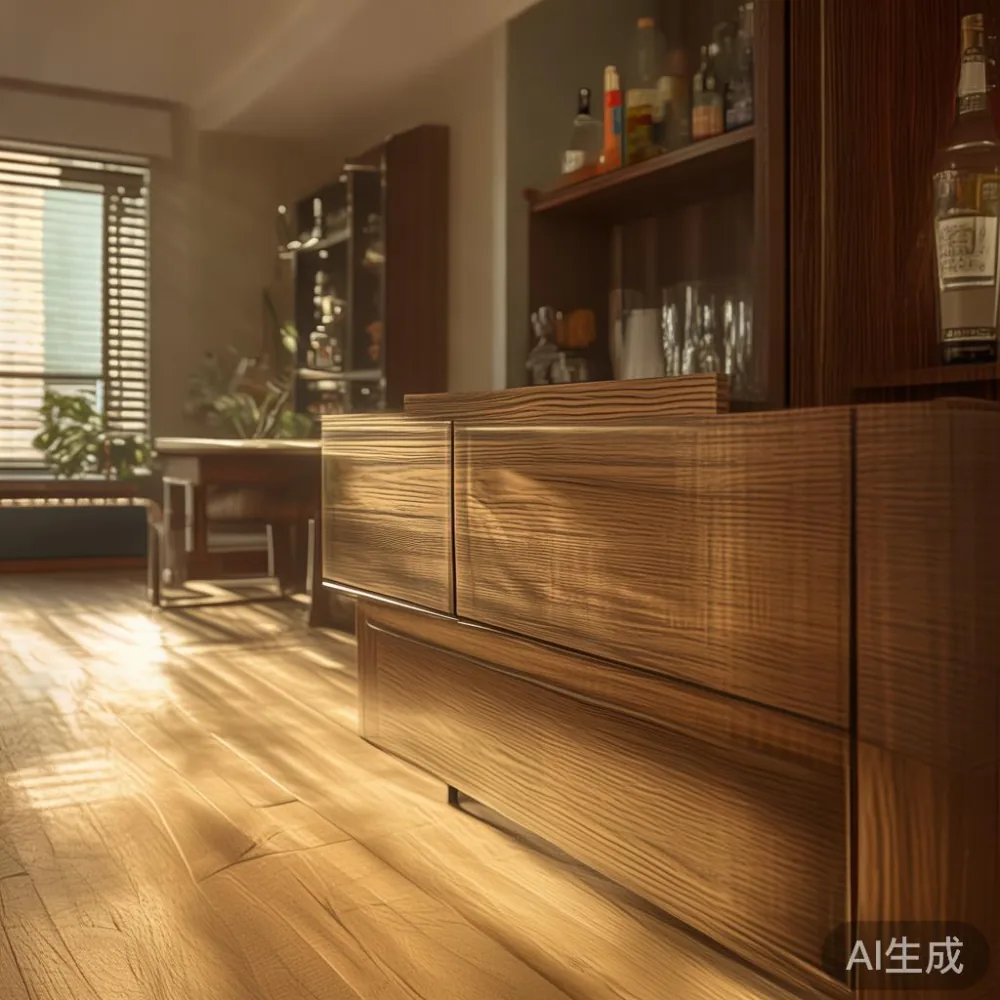
When that kiln-dried board leaves the workshop at 9% and sits in a 75% RH flat, it tries to climb toward 19%. It cannot get there overnight, but across a six-week wet phase, it inches upward, and the board grows. Across the grain, a 25 mm solid oak panel can swell by 1.5 mm to 2.5 mm, which is enough to make a bar cabinet door stick in its rebate or stop a magnetic catch from engaging. That is the symptom most people call warping, but it is really expansion. Once the air-conditioning season arrives and RH drops to 55%, the same panel gives the moisture back, and gaps open at the joints. This breathing is normal for solid wood. What is not normal is rapid cycling: a bar cabinet pushed from 85% RH to 45% RH within 48 hours by an over-eager dehumidifier can check, split, or crack at the glue lines.
Is Southeast Asian humidity different from what Foshan workshops test for?
Yes, in two specific ways that matter to a buyer in Singapore or Johor. First, our coast sees a smaller annual swing than northern China, but a larger daily swing inside an air-conditioned HDB flat where the door is opened and closed all day. Second, our homes often sit at 24°C to 27°C, a temperature band that lets mould spores germinate on dust-coated panels if RH stays above 70% for 48 hours. Foshan workshops test for these conditions in our 1.6 m × 1.6 m × 2.4 m climate chambers, but I have also learned to trust what my colleague calls the Bedok test: if a prototype survives six weeks in his ground-floor HDB without a crack at the rails, it will survive anywhere in Singapore.
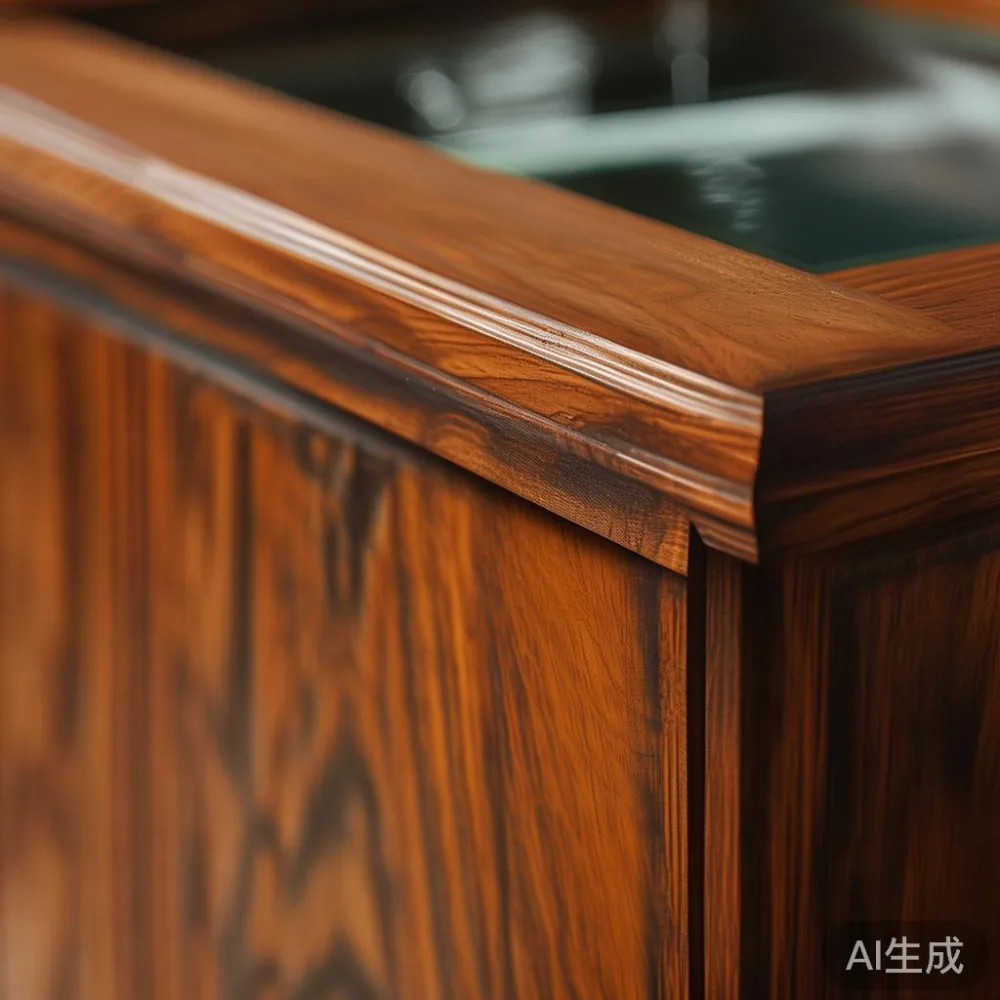
For a typical bar cabinet measuring 180 cm wide × 45 cm deep × 200 cm tall, weighing around 95 kg to 120 kg depending on the marble table top insert, the humidity stress concentrates on three areas: the side panels that face the kitchen, the top panel that faces ceiling heat, and the back panel that sits one centimetre off the wall. These are the panels I check during my quarterly visits to customers in Punggol and Sengkang. Last month I visited a 92 sqm condo off Tampines Hub where the owner had a bar cabinet placed 8 cm from a tiled wall. After eight months, the back panel had bowed by 4 mm inward, not because the wood was bad, but because the gap trapped still air, and that trapped air was wetter than the room. The fix was simple: pull the cabinet 3 cm further off the wall so air could move behind it, and the panel relaxed on its own within three weeks.
What is the difference between French corner sofa and modern furniture?
A direct answer: a French corner sofa is a light-luxury seating piece with a single L-shaped chaise extension, tufted back cushions, and cabriole or tapered wood legs in walnut or beech, while modern furniture refers to a broader design language that uses clean lines, lower profiles, mixed materials, and minimal ornamentation on everything from a bed frame to a wardrobe to a nightstand. The French corner sofa belongs to a specific decorative tradition shaped by 18th-century French salons, with curved silhouettes and soft upholstery that point to motifs, whereas modern furniture follows the Bauhaus and Scandinavian movements of the 20th century with flat surfaces, exposed joinery, and a focus on function. In Singapore showrooms you will see both sitting under the same roof: a French corner sofa in boucle or velvet priced from SGD 3,800 to SGD 7,200 for a five-seater, and modern furniture pieces from a solid wood sofa in ash to a low dining table in walnut priced from SGD 2,400 to SGD 5,600 for a six-seater. The light-luxury category that has grown here since 2021 includes French light luxury, American light luxury, and post-modern light luxury, each blending traditional silhouettes with modern proportions for compact HDB and condo layouts where a 2.4 m × 2.4 m living zone is a common constraint.
The same language distinction applies to a bar cabinet. A French-inspired bar cabinet tends to be 180 cm to 200 cm tall with glazed upper doors, brass cup pulls, and a single marble table top insert in Carrara or Calacatta, while a modern bar cabinet is usually 150 cm to 170 cm tall with flat slab doors, push-to-open catches, and an integrated LED strip at 3000K. We make both, and the choice in a humid climate is not really aesthetic: it is mechanical. A French-style bar cabinet with raised panel doors has more glue line per square metre, which means more places for humidity to express itself, while a modern slab-door bar cabinet has fewer joints and rides out the wet season with less visible movement.
How should a Singapore owner acclimate a bar cabinet after delivery?
Leave it in its crate for 72 hours in the room where it will live, then uncrate, wipe every panel with a dry microfibre cloth, and leave the cabinet empty for another 7 days before loading it with bottles. This is the routine I have used since 2017, and I have not had a single humidity-related claim in 2024 across the 1,400 plus units we shipped into Singapore and Johor. The crate is not just packaging, it is a buffer that lets the wood adjust from the container atmosphere, which is often 18°C and 95% RH inside a 12 m × 2.4 m × 2.6 m reefer-less container, to your living room. Opening the crate immediately exposes the panels to a 9°C temperature swing and a 25-point RH swing, and the wood will protest within days.
Once the bar cabinet is in place, three small habits make the largest difference:
Keep it 3 cm off the wall. Air circulation behind the cabinet keeps the back panel dry. In a HDB corridor that is only 1.2 m wide, this also lets you clean behind without dragging a 95 kg cabinet across your floor and damaging the skirting.
Run the air-conditioning or a dehumidifier to 55% RH target. A 12L/day dehumidifier costs around SGD 280 to SGD 420 and uses about 1.8 kWh per day, which works out to roughly SGD 35 a month on the SP tariff. That is a small price to protect a SGD 3,200 bar cabinet or a SGD 4,800 bed frame.
Wipe the marble table top weekly with a pH-neutral cleaner. Marble is calcite sensitive, and our local rainwater is mildly acidic at pH 5.6, which means condensation rings on a bar cabinet top can etch the polish in three months if left unattended. A quick wipe with a dry cloth and a weekly clean using a marble-specific spray at SGD 18 a bottle keeps the surface sharp.
Does MIDHILL build bar cabinets differently for tropical climates?
Yes, and I want to explain what we do, not as a sales pitch but as the engineering reality of shipping a 220 kg wardrobe or a 110 kg bar cabinet from a 9% EMC workshop to an 80% RH HDB. Three small changes make the difference. First, we dry our solid wood to 8% to 9% EMC in our Foshan kilns, which is 1 to 2 points below the Singapore target of 19%, so the wood arrives under-humidified rather than over-humidified. Under-humidified wood absorbs moisture slowly and evenly; over-humidified wood loses moisture, which causes shrinkage and cracks. Second, we use a 0.5 mm expansion gap on every back panel and a 1.5 mm gap on every door rail, which is invisible to the eye but absorbs the 2 mm to 3 mm of seasonal movement I described earlier. Third, we finish every interior surface with a moisture-cured polyurethane at 35 g/m² coverage, which slows the EMC climb by 30% to 40% in the first six weeks.
What we do not do is use MDF or particleboard for the structural panels of a bar cabinet, even when the price pressure from a buyer comparing our quote to a competitor's is real. A solid wood bar cabinet costs around SGD 2,800 to SGD 4,400 depending on width and marble table insert, and an MDF bar cabinet costs around SGD 1,400 to SGD 2,200, but the MDF version will swell at the first sign of a leaking glass or a wet glass left on the top. That is the trade-off we ask our customers to understand.
Can a homeowner in Punggol fix a slightly swollen bar cabinet door?
Yes, in two specific cases. If a door has swollen by 1 mm to 2 mm and is sticking in its rebate, do not plane it down in the wet month. Instead, run the dehumidifier for 10 days at 50% RH target and recheck. Most minor swelling reverses itself once the EMC drops. If the door is still tight after 14 days, mark the high spot with a pencil, lift the door off its European-style cup hinge using a 3 mm hex key, and plane 0.5 mm off the high corner. Never plane more than 1 mm, because you cannot put wood back. I have walked customers through this over WhatsApp video from our showroom in Foshan, and the fix usually takes 20 minutes.
If a back panel has bowed inward, the fix is also simple: relocate it 3 cm further off the wall and let the room weight it flat over four to six weeks. If the bow exceeds 6 mm, we will send one to you under our 10-year structural warranty, which covers joint failure, frame cracking, and excessive bowing. Lift access in most HDB blocks caps at 2.4 m wide × 2.1 m tall × 1.5 m deep and around 1,000 kg per trip, which means a fully assembled 220 kg wardrobe or a 110 kg bar cabinet can be delivered without disassembly in most Singapore blocks. In older blocks with 1.8 m lift openings, we deliver flat-pack and assemble in situ at no extra SGD charge above the SGD 350 free-shipping threshold.
What about Italian light luxury wardrobe sg uae, and how does that connect to a bar cabinet?
The Italian light luxury wardrobe category that has grown in Singapore and the UAE since 2022 shares its core construction logic with a high-end bar cabinet: solid wood frames, dovetail drawer boxes, soft-close European hinges, and either a marble table top insert or a back-painted glass panel. The piece that travels best across climates from Milan to Dubai to Singapore is the one with a thicker frame, a lower profile, and a finish that resists UV yellowing. A 240 cm wide × 220 cm tall × 60 cm deep wardrobe weighing around 280 kg will behave in a Dubai apartment at 28°C and 55% RH much the same way it behaves in a Punggol condo at 28°C and 75% RH, with a single difference: the Singapore piece will absorb more moisture through the back panel because the wall cavity in a HDB flat is often slightly damper than a Dubai interior plaster wall. The Italian light luxury wardrobe sg uae category has taught us that buyers in both climates want the same things: clean joinery, quiet doors, and a finish that ages into a soft patina rather than a flaky crust.
How often should a Singapore owner refinish a solid wood bar cabinet?
For a bar cabinet that sees daily use, refinish the marble table top every 18 months and the wood exterior every 5 to 7 years. We offer lifetime refinishing on every piece we ship out of Foshan, which means you ship the cabinet or a single panel back to our facility, and we strip, stain, seal, and ship it back to you for a flat SGD 280 per panel. Most owners in Singapore and Johor send us the top panel only, because the marble table top takes the brunt of glass rings, while the side panels show little wear. For a solid wood dining table or bed frame, the same rule applies: refinish the top every 5 to 7 years and the base every 10 to 12 years.
What you should never do is sand a panel without sealing it again within 48 hours, because exposed raw wood climbs toward the local EMC within hours, and the surface will feel fuzzy or raised by morning. I learned this from a customer in Bedok who sanded his nightstand on a Saturday afternoon and called me on Sunday morning because the surface had gone rough. We walked him through a wipe-down with a damp cloth, a 24-hour rest, and a re-sand at 320-grit followed by a wipe-on polyurethane at SGD 22 a bottle, and the panel settled flat by Wednesday.
What does a sensible care routine look like across the year?
Across a typical Singapore year, I tell my customers to follow four seasonal checks. In January to March, the RH is lower at 65% to 75% and the wood is shrinking slightly, so check for gaps at the rails and apply a paste wax at SGD 18 a tin to any exposed end-grain. In April to June, the RH climbs to 75% to 85% and the wet season arrives, so check that the dehumidifier is running and that the bar cabinet has 3 cm of airflow behind it. In July to September, the air-conditioning season peaks and the RH drops to 55% to 65%, so check that no door is sticking and that no marble table top is showing condensation rings. In October to December, the RH climbs again to 70% to 80%, so wipe every panel with a dry microfibre cloth weekly and avoid leaving wet glasses on the marble table insert.
This routine takes 10 minutes a week and prevents 90% of the calls I receive from customers in Tampines, Bedok, and Punggol. It is the same routine I use on the solid wood bar cabinet in my own home, and on the dining table, the bed frame, the wardrobe, and the nightstand in my guest room. A bar cabinet is a 15-year to 25-year piece if you give it that small weekly attention, and it will outlast two air-conditioner replacements and at least one HDB resale cycle. The 14-day return window is your safety net if a panel arrives with an exception you can see on day one, and the 10-year structural warranty covers the joinery if anything fails under normal indoor conditions.
Singapore is one of the kindest places on earth to live and one of the hardest places on earth to keep wood flat. The two facts are not in conflict, they just require a small weekly habit and a small piece of equipment. If you follow the routine above, a bar cabinet, or a solid wood sofa, a bed frame, a dining table, a wardrobe, or a nightstand from MIDHILL will ride out the wet season, the dry season, and the next fifteen Chinese New Years without a single cup ping.