Bar Cabinet Singapore: A Buyer’s Guide to Size, Storage and Humidity
Practical bar cabinet buying advice for Singapore homes, covering dimensions, storage, materials, humidity, prices, delivery and assembly.
- What size bar cabinet should I buy for a Singapore home?
- How do I choose between a small, medium or large bar cabinet?
- What storage features are useful inside a bar cabinet?
- Does humidity ruin solid wood furniture in Singapore?
- How much should I budget for a bar cabinet in Singapore?
- Should I buy a bar cabinet made of solid wood or engineered boards?
- How do delivery and assembly work in Singapore apartments?
- Where should I place a bar cabinet in an HDB flat or condo?
- How do I verify quality before ordering a bar cabinet?
What size bar cabinet should I buy for a Singapore home?
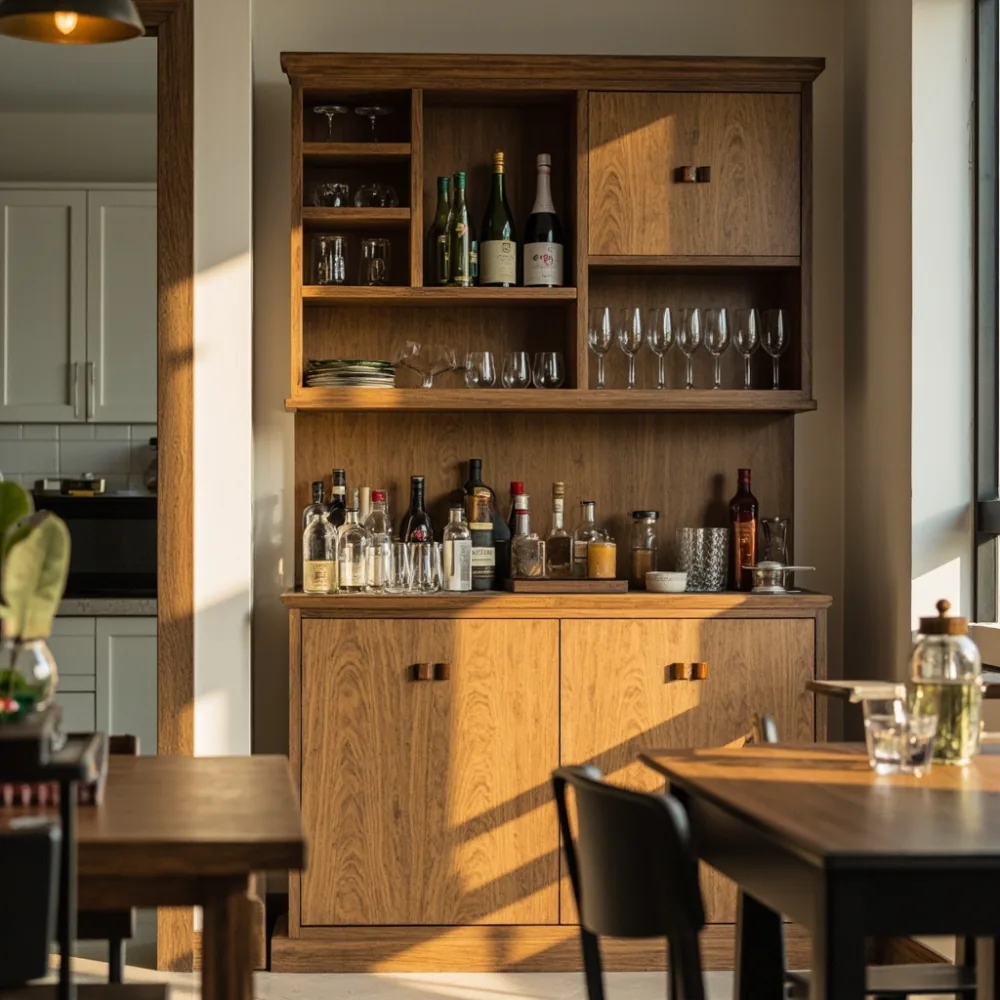
Measure the wall, doors and circulation route
Choose by storage needs, not appearance
Compare common dimensions and weights
I start with the space rather than the catalogue. In a typical HDB flat, the bar cabinet may need to sit in the living/dining area, beside a kitchen entrance or along a balcony wall. The useful dimensions are width, depth and height, but the installation space matters more than the cabinet itself.
- Leave at least 90 cm of walkway in front of drawers that open towards a main route.
- Allow for door swings, skirting boards, power sockets and air-conditioning units.
- Check that the cabinet will fit through the lift, staircase, hallway and the actual entry door.
- Measure twice after deciding where glasses, bottles and bar tools will be used.
A 100 cm-wide cabinet is often practical for a condo dining room, while an 80 cm model can work in an HDB living area. A 120 cm unit gives more storage but should not block a doorway or make the room feel narrow. I would avoid buying a very tall cabinet unless the ceiling height and visual proportions support it.
| Cabinet size | Typical use | Approx. weight | Indicative Singapore price |
|---|---|---|---|
| 80 × 40 × 90 cm | Small HDB corner or dining nook | 35–50 kg | SGD 450–900 |
| 100 × 45 × 100 cm | Condo living/dining room | 55–80 kg | SGD 800–1,600 |
| 120 × 50 × 110 cm | Larger dining area or dedicated bar | 85–120 kg | SGD 1,300–2,800 |
These are planning ranges, not fixed specifications. A cabinet full of bottles can weigh considerably more than the empty unit, so ask the seller for the packaged weight and loading requirements.
How do I choose between a small, medium or large bar cabinet?
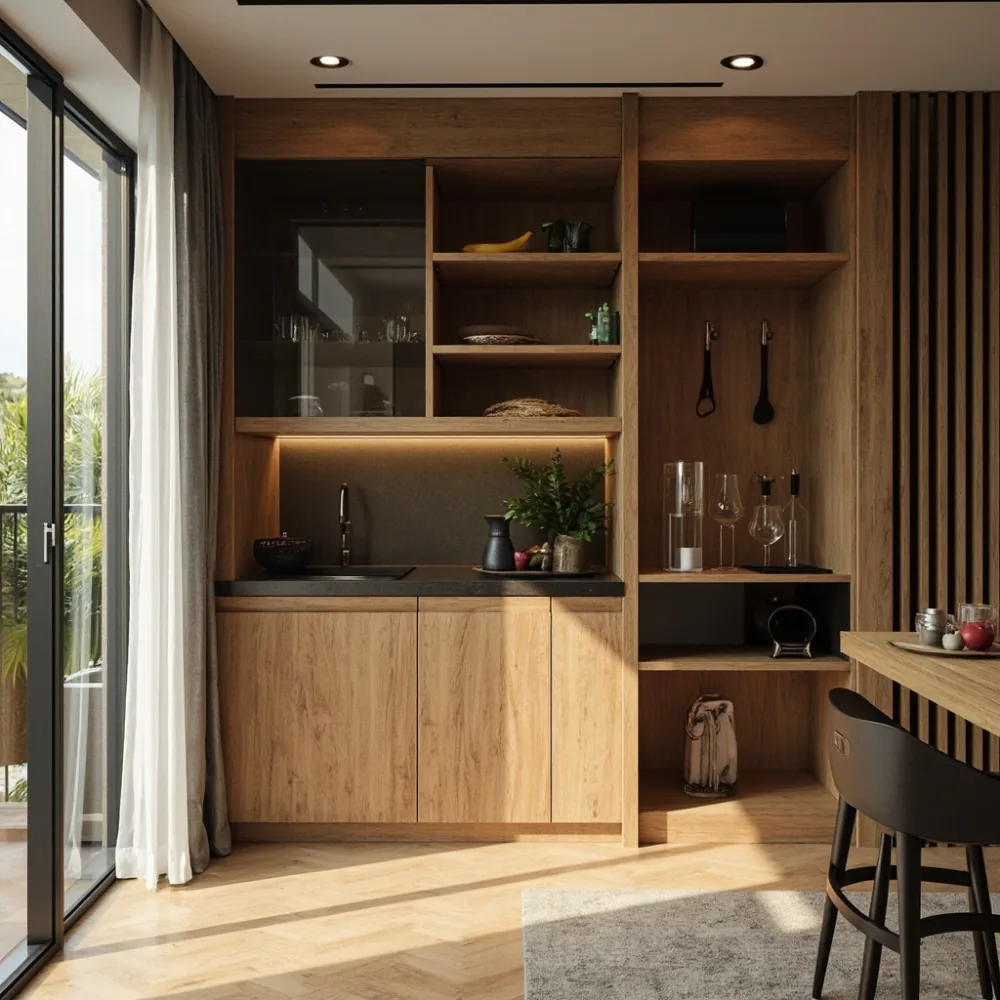
Match the cabinet to daily use
Think about bottle and glass capacity
Avoid overfilling the room
The best size is the one you can reach without making the room feel like a nightclub. For occasional use, a compact cabinet with two shelves and a drawer is enough. For regular entertaining, I prefer a model with dedicated wine storage, a serving top and a lower compartment for mixers or ice buckets.
- Small cabinet: 6–8 bottles, 8–12 glasses and bar tools in a drawer.
- Medium cabinet: 12–18 bottles, adjustable shelving and a larger work surface.
- Large cabinet: 20–30 bottles, multiple storage zones and a more substantial serving area.
Small space furniture should not mean thin, flimsy construction. Look for stable feet, useful shelf heights and drawers that do not sag when loaded with bottles. If you want a hidden bar, choose a lower cabinet with a lift-up door; if you want to display your collection, open shelving needs less door clearance but shows dust and humidity exposure.
For most Singapore apartments, I would choose a 90–110 cm-wide cabinet. It gives enough room for a bottle arrangement and glasses while keeping the footprint controlled. A larger unit makes sense only when the dining area has spare circulation space or when the bar is the main feature of the room.
What storage features are useful inside a bar cabinet?
Adjustable shelves for different bottle heights
Drawer layouts for bar tools
Glass racks and wine bottle dividers
Storage is where a cheap bar cabinet often becomes frustrating. I check whether shelves can be repositioned, whether bottle dividers are angled correctly and whether the drawer depth can hold a corkscrew, muddler, jigger and bottle opener without everything rolling around.
- Adjustable shelves are more useful than a fixed row of narrow compartments.
- Doors with soft-close hinges reduce slamming and protect glassware.
- A pull-out tray keeps the working surface clear when glasses are in use.
- Ventilation slots help protect contents in a humid apartment, but they should not be treated as a substitute for climate control.
For wine, keep bottles away from direct sunlight and heat. For spirits, closed storage is more practical and less dusty. If the cabinet is made for display, I prefer a combination of closed lower compartments and open upper shelves, with the most attractive bottles at eye level. Make sure the shelf spacing matches your usual bottle sizes; tall Champagne bottles need around 33–36 cm of vertical clearance.
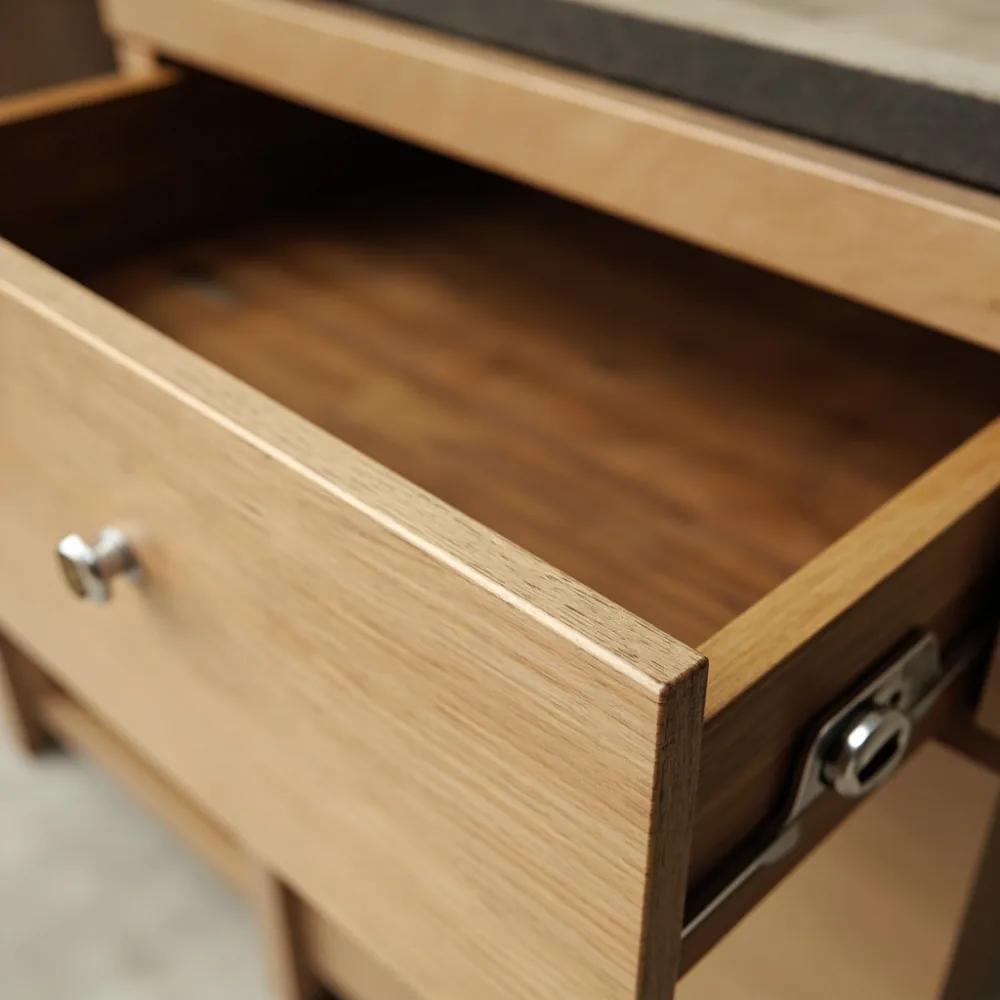
I also check the drawer runners. Full-extension metal runners are more convenient than short rails, especially when the cabinet is loaded and the drawer sits near the edge of the unit. A locking drawer is useful in a home with children, but a simple push-to-close mechanism is usually enough for most adults.
Does humidity ruin solid wood furniture in Singapore?
Understand movement in solid wood
Control moisture near windows and balconies
Choose finishes and hardware for humid conditions
Singapore humidity can affect solid wood furniture, but a cabinet does not need to be treated like a disposable item. Wood naturally expands and contracts as moisture changes. The main risks are swelling, joint movement, sticking doors and finishes that develop small cracks when the cabinet is repeatedly exposed to damp air.
- Keep the cabinet 20–30 cm away from open windows and balcony doors where possible.
- Use a dehumidifier in rooms that regularly exceed 70% relative humidity.
- Wipe condensation promptly and do not stand the cabinet on a damp floor.
- Choose a finish with a clear protective layer and stable hardware that tolerates seasonal movement.
Solid wood furniture is still a sensible choice for a bar cabinet because the material is repairable and can be refinished. The key is a stable indoor environment and regular care. I would be cautious with very thin panels, particleboard carcases exposed to spills, or MDF edges that have not been properly sealed. A seller should be able to explain the wood species, board thickness, finish and warranty rather than simply labelling everything as “wood”.
For coastal-facing condos, I would ask for sealed undersides and back panels, then inspect them during delivery. Furniture that has stood in an unfinished corridor or wet loading area should acclimatise indoors for 24–48 hours before assembly or loading.
How much should I budget for a bar cabinet in Singapore?
Compare entry, mid-range and premium options
Account for delivery and assembly
Judge value by construction, not just finish
A useful bar cabinet in Singapore commonly costs from about SGD 450 to SGD 2,800, depending on size, materials and custom work. The price gap usually reflects the quality of the frame, drawer mechanisms, finish, shelf engineering and whether the cabinet is locally assembled or imported as a flat pack.
| Type | Typical dimensions | Price range | What to inspect |
|---|---|---|---|
| Entry-level | 80–100 cm wide | SGD 450–900 | Panel alignment, drawer strength, door hinges and finish |
| Mid-range solid wood | 100–120 cm wide | SGD 1,000–2,000 | Wood thickness, shelf loading and warranty |
| Custom or premium | 120–180 cm wide | SGD 2,000–5,500+ | Joinery, custom inserts, hardware and installation |
Ask whether the quoted price includes legs, handles, shelves, protective feet and delivery. In Singapore, a staircase or lift surcharge may add SGD 50–200, while full in-home assembly can add another SGD 80–250. For a heavy cabinet, the delivery fee should also cover carrying it to the correct room and removing packaging, not merely leaving it at the lobby.
I compare the total landed cost, not just the catalogue price. A slightly more expensive cabinet with solid drawer boxes, better runners and a clear structural warranty may be cheaper over time than a low-cost unit that needs adjusting after one year.
Should I buy a bar cabinet made of solid wood or engineered boards?
Compare the benefits of each construction
Check the parts that receive the most wear
Ask about the maker and warranty
Both can work, but I choose the material according to how the cabinet will be used and how much humidity it faces. Solid wood is attractive, strong and repairable, particularly for a serving cabinet that will hold bottles. Engineered boards can offer more uniform pricing and lighter weight, but the edges, joints and fixing points need careful attention.
- Solid wood: better for premium appearance, repairability and long-term durability when properly finished.
- Engineered boards: useful for lighter, budget-friendly designs and easier installation.
- Metal accents: helpful for a compact bar, but they can scratch and show fingerprints.
- Glass doors: good for display, though they add weight and require more careful handling.
For solid wood furniture, ask whether the sides, top, back and drawer fronts are solid timber or veneers over a different substrate. The top and drawer boxes receive the most physical stress. I also check that screws are fitted into solid rails rather than thin decorative panels, and that the doors can be adjusted if the timber moves.
MIDHILL is a Foshan solid-wood furniture maker established in 2008, with a 10-year structural warranty. That type of structural commitment is useful when comparing a product, although I would still check the exact scope, exclusions and local service arrangements before ordering.
How do delivery and assembly work in Singapore apartments?
Measure access before ordering
Plan for the delivery window and packaging
Check assembly and damage procedures
Delivery is one of the most overlooked parts of buying a bar cabinet. HDB corridors, lift dimensions and tight unit entrances can turn a simple purchase into a difficult move. I send the seller photographs of the lift door, lift car, staircase turns and the route to the dining area. The cabinet’s largest packaged dimension matters more than its listed width.
- Confirm whether delivery is to the lobby, the door or the room beside the installation point.
- Book a time when the loading bay or parking area is available.
- Ask whether the team removes packaging, assembles the cabinet and takes away the carton.
- For split-level homes, mention stairs, corners, narrow turns and the number of people needed.
Allow roughly 1–3 hours for delivery and assembly for a standard cabinet in a lift-accessible condo or HDB block. Stairway delivery may take longer, especially if the cabinet is solid wood and weighs over 80 kg. A professional team should protect floors, connect the doors and level the cabinet with adjustable feet. If the cabinet is fixed to the wall, the installer should use appropriate anchors rather than assuming every wall is masonry.
Inspect the cabinet before the team leaves. Check the top, corners, glass doors, drawer alignment and shelf pins. Photograph any damage immediately and keep the delivery note until the issue is resolved.
Where should I place a bar cabinet in an HDB flat or condo?
Use the dining area without blocking circulation
Balance display and storage needs
Consider power and lighting
I place the cabinet where people will naturally reach it, not simply against the first available wall. Beside the dining area is usually best, provided the cabinet does not narrow the route to the kitchen. In a compact HDB living/dining room, a low cabinet around 90 cm high may preserve openness better than a floor-to-ceiling unit.
- Keep at least 90–100 cm between the cabinet front and the opposite wall or furniture.
- Avoid placing it directly beneath an air-conditioning vent or beside a hot kitchen appliance.
- Use the living room wall for a display bar if dining space is too tight.
- Check nearby power outlets if you plan to add a small refrigerator, LED strip or charging point.
In condo districts such as Tanjong Pagar, Geylang or Kallang, access can be straightforward through the main lobby, but parking and loading arrangements still need confirmation. In older HDB blocks, the lift size and service corridor are often the deciding factors. I would bring a tape measure to the site and, if possible, compare the cabinet with a similar unit already displayed in the building.
Lighting matters more than many buyers expect. A narrow LED strip under the top shelf can make glassware visible without adding visual clutter, but it should be installed after the cabinet is positioned. I also avoid placing valuable bottles where children can reach them.
How do I verify quality before ordering a bar cabinet?
Ask specific product questions
Check finish, joints and hardware
Compare custom furniture and standard sizes
My checklist is practical rather than technical jargon. I open and close every drawer, look inside the shelves, check the alignment of the doors and press gently on the joints. A well-made bar cabinet should feel stable when loaded, even if it is not heavy enough to be immovable.
- Confirm the external dimensions, internal shelf spacing and maximum recommended load.
- Ask whether the finish is lacquer, veneer, laminate or an oil-wax treatment.
- Check the type of hinges, drawer runners, handles and adjustable feet.
- Request photos of the actual cabinet and packaging, not just a rendered image.
- Confirm the warranty, lead time, return policy and damage-replacement process.
Custom furniture is useful when you need a specific width, a built-in wine fridge or a finish that matches existing dining pieces. It normally takes 4–8 weeks, though the maker may quote longer for a bespoke design. Standard sizes are often quicker—about 1–3 weeks for in-stock items—but availability should still be confirmed. Durable furniture is not only about the surface; the frame, fixings and hardware matter too.
I also compare the product against the floor area and the rest of the home. A bar cabinet should look intentional, but it should not dominate the room or make the dining table feel crowded. The best choice balances storage, access, material and the realities of your apartment.
Frequently asked questions
What is the most practical bar cabinet size for a Singapore apartment?
For most HDB flats and condo dining areas, I recommend 90–110 cm wide, 40–50 cm deep and about 90–100 cm high. Leave at least 90 cm of walkway in front, and measure the lift, stairwell and entry door before ordering. A larger cabinet is worthwhile only if you need more bottle storage or have a dedicated bar wall.
Are bar cabinets suitable for humid Singapore conditions?
Yes, provided they are made from stable, properly sealed materials and placed away from damp windows or balconies. Use a dehumidifier when humidity stays high, wipe spills quickly and inspect moving doors or drawers. Solid wood can handle humidity well, but it naturally expands and contracts with moisture changes.
How much does a bar cabinet cost in Singapore?
Expect roughly SGD 450–900 for an entry-level cabinet, SGD 1,000–2,000 for a mid-range solid-wood model and SGD 2,000–5,500 or more for custom or premium work. Delivery and assembly can add SGD 130–450, depending on access, stairs and the cabinet’s weight.
Should I buy a bar cabinet with doors or open shelves?
Doors keep glasses and bottles cleaner and protect them from dust, making them practical in an HDB living area. Open shelves create a stronger display feature and are easier to access, but they require more tidiness. A mixed design with closed lower storage and open upper shelving is often the most flexible.
How long does bar cabinet delivery and assembly take?
A standard cabinet in a lift-accessible HDB or condo generally takes about 1–3 hours from arrival to placement and assembly. Stairway delivery or a cabinet weighing more than 80 kg may take longer. Confirm whether the service includes carrying to the room, assembly, levelling and packaging removal.
Questions about sizing, fabric or delivery?
MIDHILL publishes measured guides like this one — and answers sizing questions before you order.
See the collection